
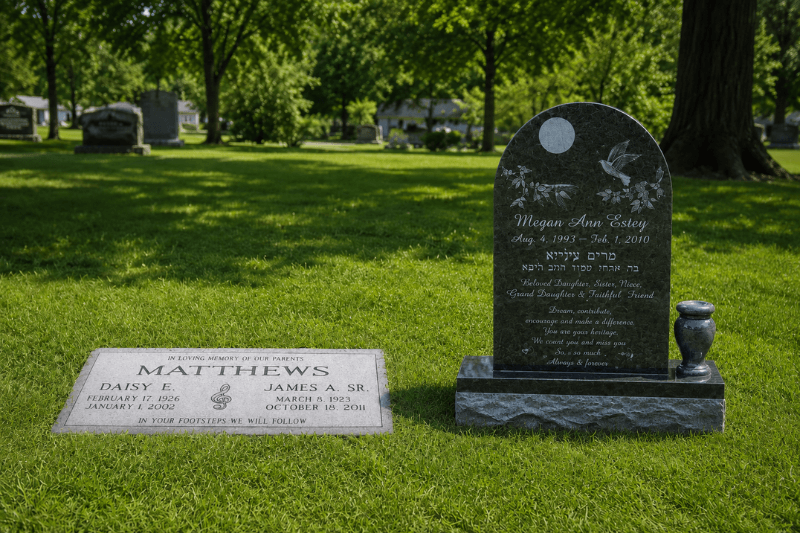
A flat grave marker is usually best for families who want a lower-profile, more affordable memorial or whose cemetery requires flush markers, while an upright headstone is usually best for families who want greater visibility, more design space, and a traditional monument appearance.
Choosing between a flat grave marker and an upright headstone begins with one practical step: confirming what the cemetery allows. After that, the decision comes down to the cost of headstones, visibility, personalization, maintenance, and the kind of memorial presence the family wants at the gravesite.
Key Takeaways
- Flat grave markers sit level with the ground and are usually more affordable than upright headstones.
- Upright headstones stand vertically, are easier to see, and offer more room for engraving and personalization.
- Cemetery rules often determine whether a flat marker, bronze marker, granite marker, or upright monument is allowed.
- Flat markers simplify cemetery lawn care but may need edging and cleaning to keep the inscription visible.
- The right choice depends on cemetery regulations, total installed cost, family preference, and long-term memorial needs.
Quick Comparison: Flat Grave Marker vs Upright Headstone
| Feature | Flat Grave Marker | Upright Headstone |
|---|---|---|
| Position | Flush or nearly flush with the ground | Vertical stone set on a base |
| Appearance | Simple, modest, uniform | Traditional, prominent, highly visible |
| Common materials | Granite, bronze, bronze on granite | Granite, sometimes marble |
| Typical cost | Usually lower | Usually higher |
| Cemetery rules | Often required in memorial parks and lawn sections | Usually allowed in monument sections |
| Visibility | Lower, especially in grass or snow | Higher and easier to locate |
| Design space | Limited but still customizable | More room for lettering and artwork |
| Installation | Set level into the ground | Requires base and foundation |
| Maintenance | Can collect grass, dirt, leaves, and water | More exposed to weather but easier to see |
| Best for | Can collect grass, dirt, leaves, and water | Visibility, tradition, larger inscriptions, family memorials |
Flat Grave Marker vs Upright Headstone: The Simple Difference
A flat grave marker lies flush or nearly flush with the ground, while an upright headstone stands vertically above the grave on a base. Flat markers create a modest, lawn-level memorial. Upright headstones create a more visible and traditional cemetery monument.
The terms can be confusing because “grave marker,” “headstone,” “gravestone,” “monument,” and “memorial” are often used interchangeably. In practical cemetery language, a grave marker is any permanent marker placed at a grave. A headstone often refers to a memorial placed at the head of the grave. A monument usually refers to a larger or more prominent memorial, especially an upright granite headstone.
A flat marker may be made from granite, bronze, or bronze mounted on a granite base. An upright headstone is most often made from granite and typically includes an upright tablet, called the die, and a horizontal base beneath it.
The biggest difference is not only height. It is how the memorial functions in the cemetery. A flat marker blends into the lawn. An upright headstone becomes a visible landmark.
What Is a Flat Grave Marker?
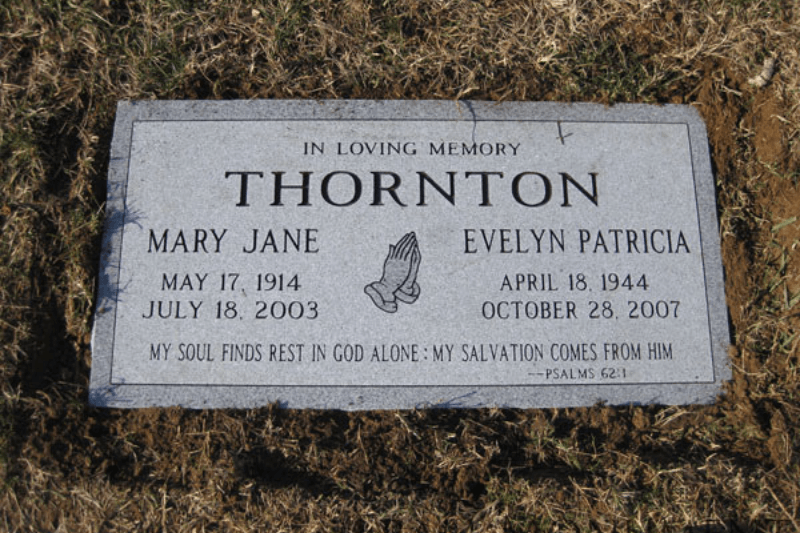
A flat grave marker is a cemetery memorial that sits level with the ground or only slightly above it. It marks the burial place and typically includes the person’s name, birth date, death date, and a short inscription, symbol, or design.
Flat grave markers are also called flush markers, grass markers, lawn-level markers, flat headstones, flat grave stones, bronze markers, or granite markers. The exact term often depends on the cemetery, the region, and the material used.
Common flat marker materials include granite and bronze, as well as bronze mounted on a granite base. Bronze markers are especially common in memorial parks, veteran sections, and cemeteries that require a uniform lawn appearance. Granite flat markers are carved directly into stone and may include polished panels, borders, emblems, or simple sandblasted lettering.
A typical single flat marker is often around 24 inches by 12 inches, although cemetery rules may require different sizes. Companion flat markers are larger and can memorialize two people on one shared memorial.
Why Cemeteries Often Require Flat Markers
Many cemeteries require flat markers because they simplify lawn maintenance. Grounds crews can mow open lawn areas more efficiently when memorials sit flush with the ground. Flat marker sections also create a consistent, park-like appearance.
This is especially common in memorial parks, garden sections, cremation sections, and cemeteries designed around open lawns rather than traditional upright monument rows.
A flat marker is not less meaningful than an upright headstone. It simply expresses remembrance in a quieter and more understated form.
What Is an Upright Headstone?
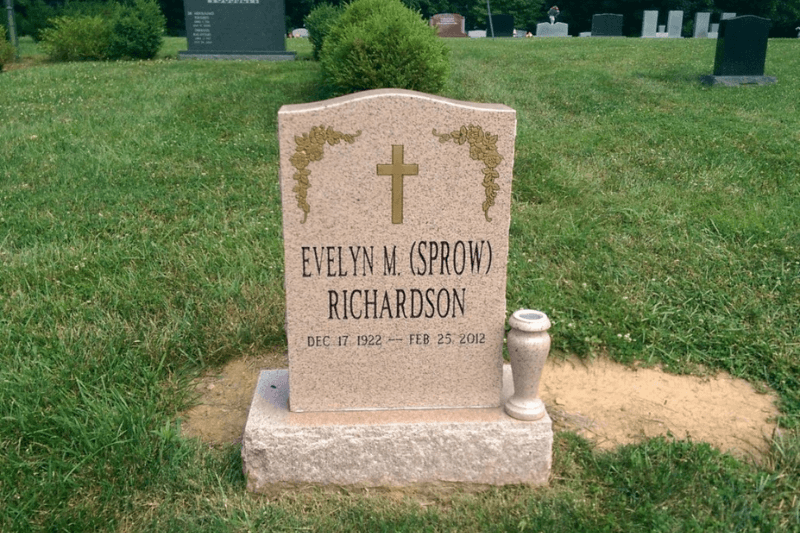
An upright headstone is a vertical cemetery memorial installed above the grave, usually made from granite and set on a base. It is the traditional monument many families picture when thinking of older cemeteries, family plots, or classic graveyards.
Most upright headstones include three important parts:
- The die, which is the upright tablet carrying the main inscription
- The base, which supports the die
- The foundation, which stabilizes the memorial beneath or at ground level
Upright headstones are commonly chosen because they are visible, traditional, and highly customizable. They can include large names, family surnames, longer epitaphs, religious symbols, floral carvings, portraits, military emblems, cultural designs, and companion inscriptions.
Common Upright Headstone Styles
A single upright headstone memorializes one person and is usually centered at the head of one grave.
A companion upright headstone memorializes two people, often with one shared surname and space for two names and two sets of dates.
A family monument may mark a family lot or multiple graves. It may include a large family name on the main monument with smaller markers or footstones for individual family members.
A custom upright monument may include shaped tops, polished sides, laser etching, porcelain portraits, religious architecture, carved flowers, or symbolic artwork.
The main advantage of an upright headstone is presence. It rises from the ground and gives the grave a visible identity within the cemetery.
Which Costs More: A Flat Marker or an Upright Headstone?
A flat grave marker usually costs less than an upright headstone because it uses less material, has a simpler structure, and is generally easier to install. Upright headstones usually cost more because they require more granite, a base, more labor, and a stronger foundation.
Flat markers are often found in the lower hundreds to low thousands depending on material, size, and customization. Upright headstones commonly begin around the low thousands and can increase significantly with companion sizing, premium granite, custom carving, portraits, vases, and cemetery foundation fees.
The most accurate comparison is not the marker price alone. Families should compare the complete installed cost.
Typical Flat Grave Marker Cost Factors
The cost of a flat grave marker depends on:
- Granite or bronze material
- Single or companion size
- Cemetery-required dimensions
- Bronze casting and mounting
- Granite color
- Polished finish
- Lettering style
- Emblems or religious symbols
- Vase options
- Installation and cemetery setting fees
A basic granite flat grave marker is usually the most affordable permanent cemetery memorial. A bronze marker often costs more than a simple granite marker because it involves casting, finishing, hardware, and a granite base.
Typical Upright Headstone Cost Factors
The cost of an upright headstone depends on:
- Size of the die and base
- Granite color and origin
- Single or companion design
- Shape and polish
- Amount of engraving
- Carved artwork
- Laser etching
- Porcelain or ceramic portraits
- Foundation requirements
- Cemetery setting fees
- Delivery and installation
A simple single upright headstone will usually cost less than a large companion monument, but both are typically more expensive than a standard flat marker.
Hidden Costs Families Should Watch For
Families often compare memorial prices without realizing that several additional costs may apply. These may include cemetery permit fees, foundation fees, installation fees, delivery, final date engraving, vase installation, custom artwork, and cemetery approval drawings.
A memorial quote should clearly explain what is included and what may be billed separately.
Cemetery Rules Usually Decide the Options First
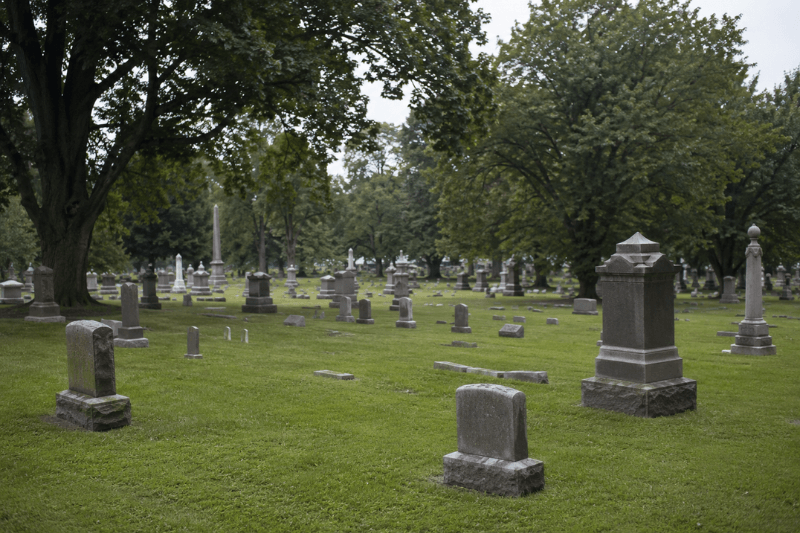
Cemetery regulations should be confirmed before choosing between a flat marker and an upright headstone. A cemetery may allow upright monuments in one section, require flat bronze markers in another section, and limit size, material, color, placement, or vase use throughout the property.
This is one of the most important parts of the memorial planning process. A family may prefer an upright headstone, but the cemetery section may allow only flush bronze markers. Another family may want a flat granite marker, but the cemetery may require bronze on granite.
The plot location often controls the memorial type.
Questions to Ask the Cemetery Before Choosing
Before ordering a memorial, families should ask:
- Does this grave section allow upright headstones?
- Are flat markers required?
- Are bronze markers required?
- Is granite allowed?
- What exact sizes are permitted?
- Is a granite base required under bronze?
- Are vases allowed?
- Are companion markers allowed?
- Who installs the memorial?
- Who provides or approves the foundation?
- Are there setting, permit, inspection, or care fees?
- Does the cemetery require a design proof before production?
- Are there restrictions on symbols, photos, languages, or epitaphs?
These questions help prevent delays, redesigns, and unexpected expenses.
Appearance and Emotional Presence
A flat grave marker creates a quiet, modest, lawn-level memorial. An upright headstone creates a more visible and traditional place of remembrance. Neither option is more respectful by default. The better choice is the one that fits the cemetery, the person being remembered, and the way the family expects to visit the grave.
Some families prefer the simplicity of a flat marker. It can feel peaceful, orderly, and understated. Other families prefer an upright headstone because it creates a stronger sense of place and is easier to recognize from a distance.
The surrounding cemetery section also matters. In a lawn-level memorial park, a flat bronze or granite marker may feel natural and appropriate. In a traditional monument section, an upright headstone may better match the surrounding memorials.
When a Flat Marker Feels Right
A flat marker often feels right when the family wants a simple and modest memorial. It may also be the best choice when the cemetery section is designed for flush markers.
Flat markers work well for concise inscriptions, traditional bronze designs, veteran memorials, and families who prefer a memorial that blends gently into the landscape.
When an Upright Headstone Feels Right
An upright headstone often feels right when the family wants the grave to be easy to find and visually distinct. It may also be preferred when nearby relatives have upright monuments or when the family wants a larger shared surname.
Upright headstones are especially useful for longer epitaphs, portraits, religious imagery, cultural inscriptions, companion memorials, and family lots.
Visibility and Ease of Finding the Grave
An upright headstone is usually easier to find than a flat grave marker because it stands above the ground and can be seen from a distance. Flat markers may be harder to locate in large cemeteries, especially when grass is tall, leaves are present, snow covers the ground, or many nearby markers look similar.
This practical detail can matter deeply over time. Visiting a grave should not feel confusing or frustrating. A visible memorial can make visits easier for older relatives, out-of-town family members, and future generations.
Flat markers can still be easy to find when the cemetery has clear section maps, nearby landmarks, row markers, or well-maintained grounds. Design can also help. A strong border, clear lettering, a permitted vase, or a distinctive emblem may make a flat marker easier to recognize.
Personalization: Which One Gives More Design Space?
An upright headstone usually provides more design space than a flat grave marker. It can hold larger names, longer epitaphs, religious symbols, portraits, decorative carvings, family names, and companion inscriptions with better spacing.
A flat marker can still be personal, but it requires a more concise design. The most important elements must be prioritized.
What Fits Well on a Flat Marker
A flat marker works well for:
- Full name
- Birth and death dates
- Short epitaph
- Religious emblem
- Veteran emblem
- Marriage date
- Simple floral design
- Border
- Companion names on a larger marker
- Vase, if permitted
The best flat marker designs are clean and readable. Crowded lettering can become difficult to read, especially as grass, soil, weather, and time affect the marker’s appearance.
What Fits Well on an Upright Headstone
An upright headstone works well for:
- Larger names
- Shared family surname
- Longer epitaph
- Religious or cultural inscriptions
- Portraits
- Laser-etched scenes
- Floral carvings
- Companion inscriptions
- Multiple languages
- Family lot identification
- Matching footstones
Upright monuments allow a stronger visual hierarchy. The surname can appear prominently, individual names can be placed below, and the epitaph or artwork can have its own space without making the design feel crowded.
Maintenance and Long-Term Care
Flat markers are easier for cemetery mowing, but they can collect grass clippings, soil, leaves, water, and debris. Upright headstones are more exposed to weather, but they are easier to see, easier to locate, and often easier for families to clean.
From the cemetery’s perspective, flat markers are often lower maintenance because grounds crews can mow over or around them more efficiently. From the family’s perspective, a flat marker may need periodic edging to keep grass from growing over the edges.
Common Flat Marker Maintenance Issues
Flat markers may experience:
- Grass growing over the edges
- Dirt settling into lettering
- Lawn clippings covering the inscription
- Leaves hiding the marker
- Water pooling after rain
- Snow making the marker difficult to locate
- Mower contact if the marker is not properly set
Granite flat markers are highly durable, but readability depends on proper installation and surrounding lawn care. Bronze markers naturally age over time and may develop a patina. Some families appreciate that aged appearance, while others prefer periodic cleaning to preserve contrast.
Common Upright Headstone Maintenance Issues
Upright headstones may experience:
- Weathering on exposed surfaces
- Moss, algae, or lichen growth
- Dirt streaking
- Foundation settling
- Slight shifting over many years
- Vase or base movement
- Cleaning needs around carved areas
A properly installed granite upright headstone can last for generations. The foundation is especially important because it keeps the memorial level, stable, and secure.
Installation Differences
A flat marker is installed level with the ground, while an upright headstone is installed on a base and foundation. This difference affects cost, timeline, equipment, cemetery approval, and long-term stability.
Flat marker installation is usually simpler, but precision still matters. If the marker is too high, it may interfere with mowing. If it is too low, grass and soil may cover it more easily.
Upright headstones require more involved installation. The base must be level, the foundation must support the monument’s weight, and the die must be set securely.
Why the Foundation Matters
A foundation distributes the memorial’s weight and helps prevent leaning, settling, or shifting. Soil conditions, cemetery requirements, monument size, and local weather patterns can all affect the foundation.
The memorial is intended to remain in place for generations, so installation should be treated as part of the memorial’s quality, not as an afterthought.
Flat Marker vs Upright Headstone for a Single Grave
For a single grave, a flat marker is often the better choice when the cemetery requires it, the family wants a modest appearance, or the inscription is simple. A single flat marker can be complete and dignified with a name, dates, emblem, and short phrase.
An upright headstone is often the better choice when visibility, tradition, or personalization matters more. It is especially helpful when the design includes a longer epitaph, a portrait, a religious image, or a larger family name.
For a single grave, the practical comparison is straightforward: choose a flat marker when simplicity and cemetery uniformity matter most. Choose an upright headstone when visibility and design space matter most.
Flat Marker vs Upright Headstone for Couples and Companion Graves
For couples and companion graves, both flat markers and upright headstones can work well. The decision depends on cemetery rules, plot layout, inscription needs, and future engraving.
A companion flat marker can include two names, two date areas, a shared surname, a wedding date, and a central emblem. It is a strong option when the cemetery requires flush memorials.
A companion upright headstone offers more design flexibility. It can include a larger surname, two individual inscriptions, a shared epitaph, religious symbols, portraits, and space for final date engraving later.
When one spouse is living, the memorial should be designed so the final date can be added later without making the layout feel unbalanced.
What About Bronze Markers?
A bronze marker is a cast bronze plaque, usually mounted to a granite base and installed flat at the grave. Some cemeteries require bronze markers to maintain a consistent appearance across the lawn.
Bronze markers can include raised lettering, borders, emblems, vases, military symbols, religious symbols, and companion layouts. They have a formal and traditional appearance even though they sit flat.
The main considerations are cemetery requirements, total cost, production time, and long-term appearance. Bronze naturally changes outdoors over time. That aging process can create a dignified patina, although cleaning may be needed to maintain contrast and readability.
What About Veterans’ Markers?
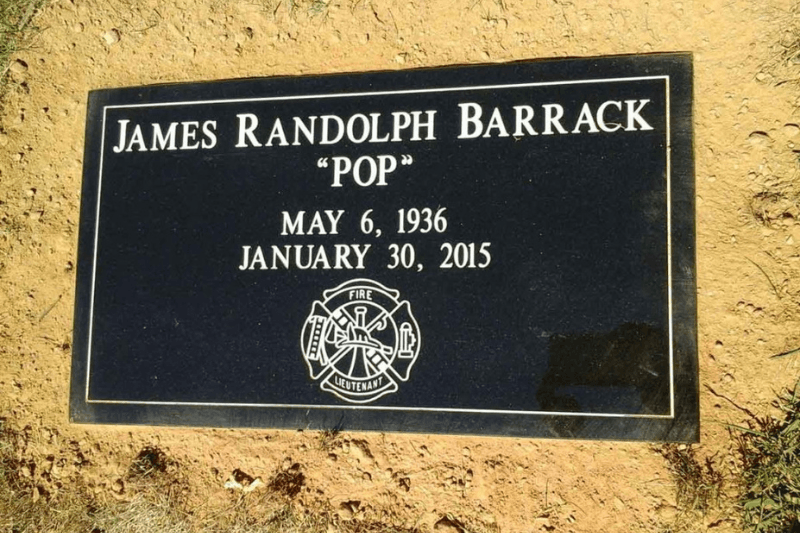
Veterans may be eligible for government-furnished grave markers or headstones, depending on eligibility, cemetery rules, and place of burial. Veteran memorial options may include flat bronze markers, flat granite markers, flat marble markers, and upright headstones.
In private cemeteries, families still need to confirm what the cemetery allows. A cemetery may accept a flat bronze veteran marker but require a granite base or charge a separate installation fee. Another cemetery may allow an upright veteran headstone only in certain sections.
For veteran memorial planning, families should confirm eligibility, cemetery approval, base requirements, and whether the marker should coordinate with a spouse’s or family memorial.
When a Flat Grave Marker Is the Better Choice
A flat grave marker is usually the better choice when the cemetery requires flush memorials, the family prefers a modest design, or the budget is better suited to a simpler memorial.
A flat marker may be the right choice when:
- The cemetery requires flat markers
- The family prefers a low-profile memorial
- Budget is a major consideration
- The inscription is short
- The cemetery section has a uniform lawn design
- A bronze marker is required
- The memorial is for one person with simple details
- The family wants a clean and understated appearance
A flat marker does not represent a smaller tribute. It represents a different style of remembrance.
When an Upright Headstone Is the Better Choice
An upright headstone is usually the better choice when the cemetery allows it and the family wants a visible, traditional, highly personalized memorial.
An upright headstone may be the right choice when:
- The grave should be easy to find
- The family wants a traditional cemetery monument
- A larger surname is important
- The epitaph is longer
- Artwork or religious imagery is desired
- The memorial is for two people
- Nearby family memorials are upright
- The lot may become part of a larger family area
- Long-term visibility matters
The strongest reason to choose an upright headstone is not simply size. It is the ability to create a clear and lasting focal point for remembrance.
Other Memorial Options to Consider
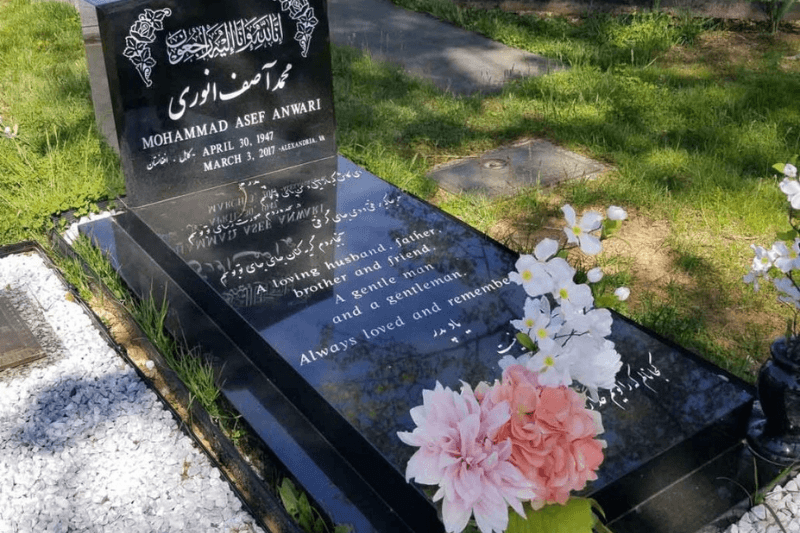
Sometimes the best choice is not a standard flat marker or a traditional upright headstone. Cemetery rules and family preferences may point toward another style.
A bevel marker is low to the ground but slightly raised and angled, making the inscription easier to read than a fully flat marker.
A slant marker is taller than a bevel marker but shorter than a full upright headstone. It provides better visibility while remaining more compact.
A ledger covers much of the grave and offers more inscription space while staying horizontal.
A memorial bench can create a place for reflection if the cemetery allows it.
A family estate memorial may combine upright monuments, ledgers, benches, coping, walkways, cremation memorials, or multiple inscriptions.
These options are useful when a family wants more presence than a flat marker but does not want, or cannot install, a traditional upright monument.
How to Choose Between a Flat Marker and an Upright Headstone
The right memorial should be chosen in a practical order: cemetery rules first, then visibility, inscription space, total installed cost, and future family needs.
1. Confirm the Cemetery Rules
The cemetery should confirm the allowed memorial type, size, material, foundation, placement, vase rules, and approval process for the exact grave location.
2. Decide How Visible the Memorial Should Be
If the grave should be easy to find from a distance, an upright headstone has a clear advantage. If a modest lawn-level appearance is preferred, a flat marker may be better.
3. Decide How Much Inscription Space Is Needed
A short inscription works well on a flat marker. A longer epitaph, portrait, family surname, or companion layout often works better on an upright headstone.
4. Compare the Full Installed Cost
The total cost should include the memorial, engraving, foundation, delivery, installation, cemetery fees, vases, design details, and future date engraving if needed.
5. Think About Future Family Needs
Families should consider whether another inscription may be added later, whether the memorial should match nearby family stones, and whether the plot may become part of a larger family memorial area.
Questions Families Should Ask Before Ordering
Before ordering a flat grave marker or upright headstone, families should ask:
- What does the cemetery allow on this exact grave?
- Is the quoted price for the memorial only or the full installed memorial?
- Is the foundation included?
- Who handles cemetery approval?
- What material is being used?
- What granite color or bronze finish is included?
- How much engraving is included?
- Are emblems, portraits, vases, or extra lettering additional?
- Will a design proof be provided before production?
- Can a final date be added later?
- Can the memorial be matched to nearby family stones?
- What maintenance should be expected over time?
- What happens if the cemetery rejects the design?
These questions help families avoid preventable delays, added costs, and design problems.
Frequently Asked Questions
Is a flat grave marker the same as a headstone?
A flat grave marker can be considered a type of headstone, but it sits flush with the ground instead of standing upright. In common use, “headstone” often refers to an upright memorial, while “grave marker” often refers to a flat memorial.
Is a flat marker cheaper than an upright headstone?
A flat marker is usually cheaper than an upright headstone because it uses less material and generally requires a simpler installation. The final price depends on size, material, engraving, cemetery fees, and customization.
Do flat grave markers last as long as upright headstones?
Granite and bronze flat markers can last for many decades when properly made and installed. Upright granite headstones are also highly durable. Longevity depends on material quality, installation, cemetery conditions, and maintenance.
Why do cemeteries require flat markers?
Cemeteries often require flat markers to maintain a uniform lawn appearance and simplify mowing. Memorial parks and lawn sections commonly use flat marker rules for consistency and groundskeeping efficiency.
Can a flat marker have a vase?
Many flat markers can include a vase, but only if the cemetery allows it. Some cemeteries permit bronze or granite vases, while others restrict vases because they interfere with mowing or maintenance.
Can two people be memorialized on one flat marker?
Yes. A companion flat marker can memorialize two people with two names, two sets of dates, a shared surname, and a central design. The cemetery must approve the size and placement.
Can an upright headstone be installed in any cemetery?
No. Upright headstones can only be installed where the cemetery and specific grave section allow them. Some cemeteries have upright monument sections, while others allow only flat markers.
Which is easier to maintain?
Flat markers are easier for cemetery lawn crews, but they may need edging and cleaning to keep grass and dirt away from the inscription. Upright headstones are more exposed to weather but are easier to locate and often easier for families to clean.
Which is better for personalization?
An upright headstone is usually better for personalization because it provides more space for lettering, epitaphs, symbols, portraits, and custom shapes. A flat marker can still be personal, but the design must be more concise.
What is the most respectful choice?
The most respectful choice is the memorial that follows cemetery rules, honors the person clearly, and gives the family a meaningful place to visit. A flat marker can be just as dignified as an upright headstone when it is thoughtfully designed.
Choosing the Right Memorial for Your Family
A flat grave marker is best when the family wants simplicity, affordability, or a cemetery-required lawn-level memorial. An upright headstone is best when the family wants visibility, tradition, and more room for personal expression.
The decision is not a choice between a lesser memorial and a greater one. It is a choice between two different forms of remembrance. One is quiet and close to the earth. The other rises as a visible landmark. Both can honor a life with dignity when the material, inscription, placement, and design are chosen with care.
At Fram Monument Company, families can get help reviewing cemetery requirements, comparing flat and upright memorial options, and choosing a design that feels appropriate for their loved one’s grave. Contact us before beginning the memorial design process for clear guidance on what is allowed, what will fit your needs, and how to move forward with confidence.