
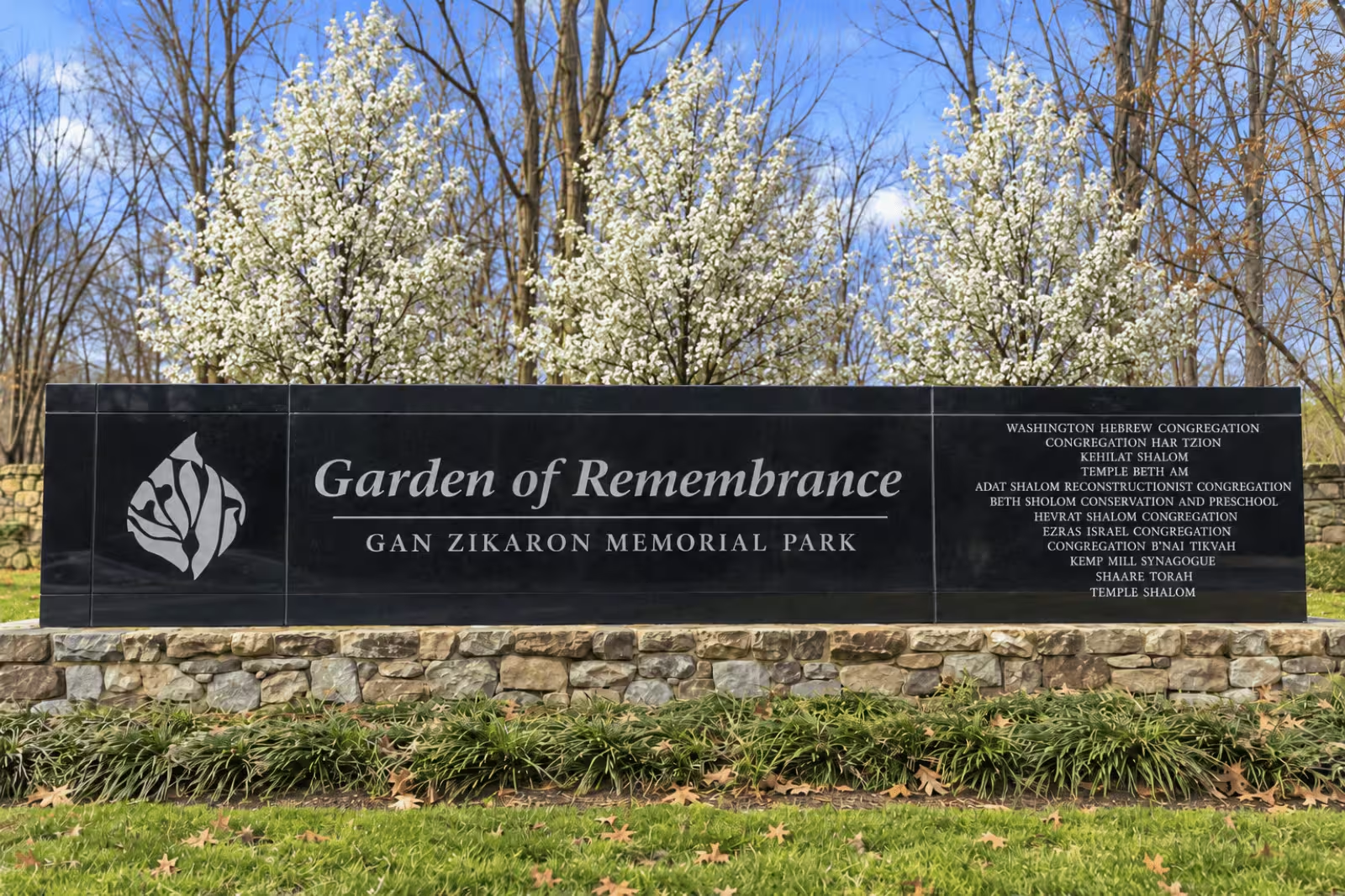
Garden of Remembrance Memorial Park in Clarksburg, Maryland, permits upright granite headstones, slant monuments, and flat granite or bronze markers in designated burial sections. Each section has its own memorial standards. The cemetery requires written approval before an outside company fabricates a memorial, and its staff or designated contractors handle installation.
Knowing the burial location is the first step toward a suitable design. Families should also review headstone pricing, since foundations, setting work, and ceremony arrangements may add to the price of the stone.
What to Know
- Memorial style, size, and placement depend on the specific burial section.
- Family Gardens use low slant markers; some Legacy Gardens allow a shared upright monument.
- Green Burial Gardens permit flat, grass-level footstones, not upright stones.
- The recorded burial-right owner or legal designee must authorize a memorial.
- The cemetery reviews outside memorial designs and controls their installation.
Garden of Remembrance Headstone Rules by Section
Also known as Gan Zikaron, the cemetery has community, family, congregational, green burial, and above-ground spaces.
| Burial section | Permitted memorial arrangements |
| Community Gardens | Individual section rules determine whether an upright, slant, granite, or bronze marker is suitable. |
| Congregational sections | Cemetery standards apply, along with approved congregational requirements for sizing, lettering, facing, and placement. |
| Family Gardens | Low slant memorial markers are used within landscaped garden beds. |
| Legacy Gardens | Some accommodate a central upright family monument with individual footstones or slant markers; certain plots have room for a granite bench. |
| Forest Glades | Families may propose memorial layouts and private landscaping or stonework, subject to advance approval. |
| Green Burial Gardens | Flat, grass-level footstones only; upright monuments are prohibited. |
| Forest View | Back-to-Nature cremation boulders have bronze covers bearing names and dates. |
| Mausoleums and columbariums | Approved inscriptions identify the person interred in a crypt or cremation niche. |
Community Gardens include Jewish-only and interfaith sections for unaffiliated families. Some have additional marker rules. Nearby headstones are not proof that a particular design is permitted.
Conservative and Reconstructionist congregations may set memorial sizing, placement, lettering, and orientation standards, provided these do not conflict with cemetery rules.
Approved Headstone and Marker Styles

Upright and Companion Granite Headstones
An upright headstone has a vertical granite tablet and base. Single and companion designs can commemorate one or two people where permitted, with room for longer inscriptions.
Slant Markers and Ground-Level Footstones
A slant monument has a face angled toward the visitor. Family Gardens use low slant stones to retain the view across the planted beds. In another section, the permissible form may be a flat marker that sits level with the lawn.
Depending on the plot, flat markers may use engraved granite or bronze plaques with raised lettering. A marker comparison can help families weigh appearance and readability before selecting a permitted style.
Family Benches and Cremation Memorials
A Legacy Garden may hold a central family-name stone with smaller individual markers. Some plots also provide room for a granite bench, but a bench should not be assumed permissible on an ordinary single grave.
Forest View serves a different kind of memorial. Its natural-looking boulders accommodate one or two sets of cremated remains, with names and dates inscribed on bronze covers. For mausoleum crypts and columbarium niches, the commemorative text appears on the designated front rather than a freestanding lawn stone.
Memorial Dimensions, Materials, and Foundations
Garden of Remembrance does not publish one monument height or width that applies to all graves. Its written rules say the director supplies the specifications for memorial size, style, composition, and foundations. That makes the section, row, and space number more useful than a general estimate of what fits a cemetery plot.
A design submission should show the stone’s height, width, and thickness, plus all three base dimensions. For bronze work, it should identify the plaque measurements and how the bronze attaches to its support. The drawing should also make the proposed granite color, surface finish, lettering, and decorative elements clear.
Foundations are part of the approval, not an afterthought. A taller tablet can need a different support from a low slant marker. The cemetery decides what is acceptable for the location and arranges setting through its own staff or designated contractor.
The park’s rules also prohibit fences, concrete curbing, edging, hedges, and other enclosures around graves. Raised grave mounds are not allowed, and footstones and grave ledgers must sit at ground level. These restrictions preserve access and a consistent appearance across the grounds.
Green Burial Memorial Requirements
Green Burial Gardens have their own rules. Only flat, grass-level footstones are permitted, and upright markers are prohibited. Concrete burial liners are also excluded from these sections.
A green burial designation does not mean families must forgo a named memorial. It means the memorial must fit the section’s ground-level approach. Before selecting a material or footprint, ask the cemetery for its exact footstone specifications. A standard raised marker from another lawn section should not be assumed suitable.
Jewish Headstone Inscriptions and Symbols

A memorial may carry an English name, a Hebrew name, dates, a personal epitaph, and Jewish symbols, subject to the cemetery’s review. The park’s published memorial information identifies English and Hebrew lettering among its available choices.
Hebrew text needs careful checking. Character order, spelling, family relationships, and Hebrew dates should match the family’s chosen wording. A monument company can prepare the layout, but the family should have someone familiar with the language review the completed proof. The meanings of Hebrew headstone inscriptions can help inform those choices.
The cemetery prohibits symbols and public prayers of religions other than Judaism. Congregational standards may narrow the available options further. Submit any religious emblem or personal artwork with the inscription proof so the entire design receives review together.
The park may require inscription corrections at the owner’s expense. Verify names and dates against family records before engraving.
Written Approval and Monument Authorization
The cemetery requires advance written consent for memorials and inscriptions. Outside providers must appear on its approved contractor list or receive permission from the director. A design approved by the family alone is not enough to begin fabrication.
The third-party monument form asks for the monument company’s contact details, the deceased’s name, purchaser’s name, and precise grave location. It also requests the monument type, color, measurements, base size, design proof, expected delivery date, and intended unveiling date.
Only the recorded owner of the interment right or a legal designee has the authority to place a memorial on that space. Where several relatives are involved, confirm who holds that authority before paying for custom work. The cemetery’s rules also require full payment for the burial right before a memorial may be erected.
Keep the signed approval and final proof. Changes to dimensions, symbols, or bases may require another review.
Installation Fees and Unveiling Arrangements
The purchase price of a headstone is only one part of the memorial expense. Garden of Remembrance charges for foundation and installation work, with amounts varying by monument type and dimensions. Outside orders may also involve supervision, stake-out, or unveiling-related charges.
The publicly available third-party authorization form gives two different figures for its unveiling-related fee. Rather than budgeting from either figure, request a written, current estimate that separates foundation work, setting, delivery arrangements, and any ceremony charge.
For a planned unveiling, the form instructs suppliers to deliver the memorial at least two weeks before the requested ceremony date. Families must contact the cemetery office to schedule the unveiling. This two-week period is a delivery requirement, not a production deadline. Manufacturing time, Hebrew lettering review, and approval can extend the full schedule. Allow for normal headstone production timelines before selecting a firm ceremony date.
The park schedules installation around nearby burials and requires advance payment.
Flowers, Vases, and Memorial Maintenance
Families may place approved flower vases at a grave, with a limit of two. The vases must meet the cemetery’s uniform standards. Flower bundles and potted plants are allowed temporarily, but permanent personal planting is not permitted on ordinary burial spaces. Glass containers and artificial or treated flowers are prohibited.
The cemetery may remove displays that conflict with its appearance and maintenance rules. Additions to crypts, niches, and other memorial spaces need prior written approval. Family-planned landscaping in Forest Glades also requires permission before any work begins.
Routine park care does not cover every private expense. Owners of Forest Glades maintain their approved special features; the park takes care of grass mowing and fallen leaves in those areas and Legacy Gardens. If an outside memorial develops a material or workmanship defect, the owner may have to pay for repairs required by the cemetery.
Steps for Ordering an Approved Memorial
- Confirm the grave details. Obtain the section, row, space number, and name of the interment-right owner.
- Request local specifications. Ask the cemetery for the permitted marker type, dimensions, materials, and any congregational conditions.
- Review the artwork. Check the monument drawing, inscription, Hebrew spelling, finish, plaque, and base.
- Get written consent. Have the authorized purchaser and cemetery approve the final design before fabrication.
- Arrange the setting. Confirm all charges, delivery instructions, contractor responsibilities, and unveiling plans.
Memorial Design Assistance From Fram Monument Company
A personal memorial deserves thoughtful lettering, fitting proportions, and a design that can be approved for the place where it will stand.
At Fram Monument Company, we help families choose and personalize granite headstones, bronze markers, and Jewish memorials for Garden of Remembrance. We can prepare drawings and inscription details for cemetery review, explain the choices available for your burial section, and help coordinate the steps toward installation.
Contact Fram Monument Company to discuss a memorial design and request a personalized quote.
Frequently Asked Questions
Upright Headstone Availability
Upright granite headstones are allowed in designated burial sections. Family Gardens use low slant markers, and Green Burial Gardens do not permit uprights. The exact burial location determines which upright designs, if any, can be approved.
Flat Markers in Green Burial Gardens
Green Burial Gardens permit flat, grass-level footstones. Upright headstones and concrete liners are prohibited there. Families should obtain the cemetery’s current measurements and material specifications before purchasing a footstone.
Independent Monument Companies
Families may buy from an outside monument company approved by the cemetery. The park must approve the memorial in writing before fabrication, and only its staff or designated contractors may install it.
Headstone Height and Width Limits
The cemetery’s published rules do not provide one universal dimension limit. Its director issues the memorial and foundation specifications for each burial setting. Ask for the limits tied to the actual grave before approving a drawing.
Hebrew Lettering and Jewish Symbols
Hebrew inscriptions and Jewish symbols may appear on memorials when they comply with cemetery requirements and any applicable congregation rules. The completed lettering and artwork should be reviewed before engraving.
Time Needed Before an Unveiling
The third-party memorial form calls for delivery at least two weeks before the intended unveiling. That does not include the time needed for approval, fabrication, or transport. The ceremony must be scheduled directly with the cemetery office.
Written by
CEO, Fram Monument Company
Niv Fishbein has helped families design, engrave, and install headstones since 2010. He brings deep knowledge of memorial traditions across many cultures, religions, and cemetery requirements.
More from Niv