
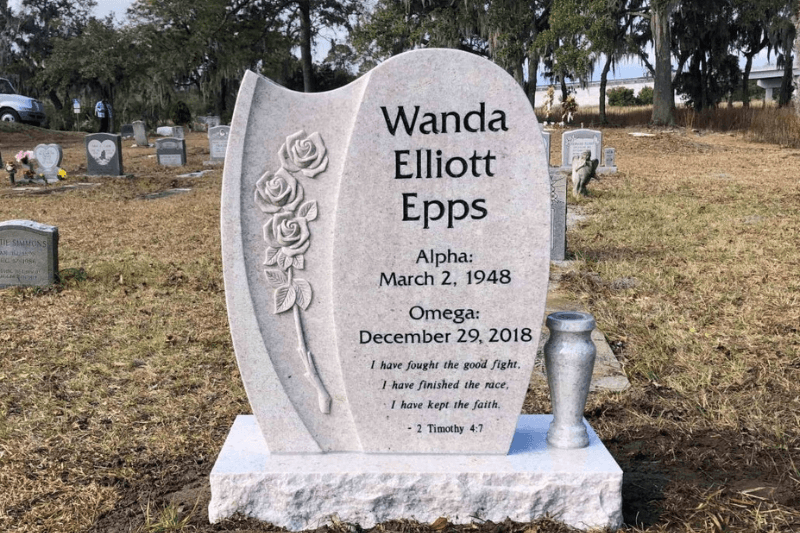
A headstone should usually include the person’s name, birth and death dates, and a short inscription that reflects their relationships, character, faith, values, or lasting influence.
The strongest headstone wording is rarely the longest. A memorial does not need to summarize an entire life. It should preserve what the family most wants future generations to know and remember.
A thoughtful inscription begins with essential identifying information and adds one clear line of remembrance. The final wording should feel personal without appearing crowded, and every element should remain legible within the monument’s available inscription area.
Key Takeaways
- Most headstones include a name, life dates, and a short epitaph or relationship line.
- The best inscription reflects the individual rather than relying only on a familiar quotation.
- One to three short lines are usually sufficient for an epitaph.
- Cemetery regulations should be confirmed before the wording and design are approved.
- Every name, date, quotation, translation, and symbol should be checked on a complete design proof.
What Is Usually Written on a Headstone?
Most headstone inscriptions combine identifying information with one brief statement of remembrance.
The exact format depends on the monument, cemetery regulations, and family preferences, but the following elements are the most common.
| Inscription element | Purpose | Example |
|---|---|---|
| Introductory phrase | Establishes a respectful tone | In Loving Memory |
| Name | Identifies the person | Margaret Louise Carter |
| Birth and death dates | Creates a permanent historical record | May 14, 1941 to October 2, 2024 |
| Relationship line | Describes the person’s place within the family | Beloved Mother and Grandmother |
| Epitaph | Expresses love, faith, character, or legacy | Her Kindness Lives On |
| Optional emblem or title | Reflects faith, service, vocation, or heritage | Cross, Star of David, military branch emblem |
Not every memorial needs every element. A name, two dates, and one meaningful sentence may create a more powerful tribute than an inscription filled with too much information.
The Person’s Name
The name is usually the largest and most prominent part of the memorial. It may include:
- Full legal name
- Middle name or initial
- Maiden name
- Nickname
- Professional title
- Military rank
- Religious title
- Suffix such as Jr., Sr., II, or III
The most appropriate choice is generally the name by which the person was known and should be recognized by future generations.
A nickname may be included when it was an important part of the person’s identity:
Margaret Louise “Maggie” Carter
When a full legal name is especially long, clarity and family significance should take priority over including every possible version of the name.
Birth and Death Dates
Dates may be written in full, abbreviated, or shown as years only.
| Format | Example | Best suited for |
|---|---|---|
| Full dates | May 14, 1941 to October 2, 2024 | Families seeking a complete genealogical record |
| Month and year | May 1941 to October 2024 | Limited space with more detail than years alone |
| Years only | 1941 to 2024 | Minimalist designs and smaller markers |
| Numeric dates | 05.14.1941 to 10.02.2024 | Contemporary layouts with clearly defined formatting |
Full dates preserve the most information. Years alone create a cleaner and more compact appearance.
The same date format should be used throughout a companion or family memorial. Consistent formatting helps the inscription look balanced and professionally designed.
Relationship or Identifying Line
A relationship line tells visitors how the person was connected to family members or the broader community.
Examples include:
- Beloved Wife, Mother, and Grandmother
- Devoted Husband and Father
- Cherished Daughter and Sister
- Loving Parents and Grandparents
- Teacher, Mentor, and Friend
- Faithful Friend to Many
A person may have held many important roles, but the headstone does not need to list all of them. Too many titles can make the inscription crowded and may unintentionally exclude someone.
Broader wording can acknowledge more relationships without overwhelming the design:
Deeply Loved by Family and Friends
A Short Epitaph
An epitaph is a brief commemorative statement placed on a headstone, grave marker, plaque, or memorial. It may express love, peace, faith, personality, service, or legacy.
Examples include:
- Forever in Our Hearts
- A Life Well Lived
- Her Love Remains
- He Served with Honor
- Together Forever
An epitaph is only one part of the full inscription. The complete memorial may also include the person’s name, dates, relationships, symbols, and other identifying information.
The Basic Headstone Inscription Format
A reliable headstone layout includes an optional opening phrase, the person’s name, life dates, and one short line of remembrance.
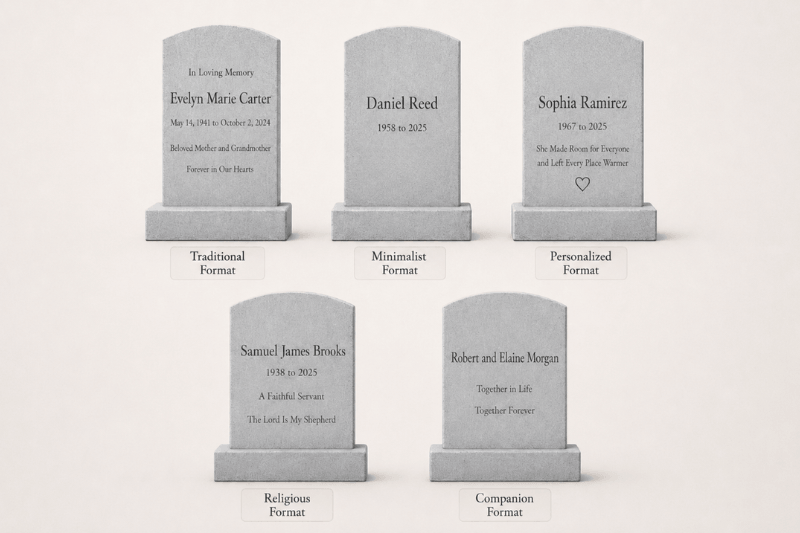
The best structure depends on the memorial type, available space, lettering style, decorative elements, and whether room must be reserved for future information.
How to Decide What a Headstone Should Say
The right inscription communicates one enduring truth about the person in language that feels natural, accurate, and emotionally honest.
Reviewing hundreds of quotes can quickly become overwhelming. A more effective approach is to decide on the message before selecting the exact wording.
Begin with one question:
What should a visitor understand about this person after reading the memorial?
The answer often relates to one of the following themes.
| Main message | Possible wording |
|---|---|
| Love | Forever in Our Hearts |
| Family | Her Love Was the Heart of Our Home |
| Faith | Well Done, Good and Faithful Servant |
| Service | He Served with Honor |
| Character | Her Kindness Made Everyone Feel Welcome |
| Legacy | His Example Lives On |
| Peace | At Rest |
| Reunion | Together Again |
Focus on the Person, Not Only the Loss
Many inscriptions describe how deeply the family misses the deceased. That expression of grief is entirely appropriate, but a memorial can also preserve something specific about the life that was lived.
Compare:
We Will Miss You Forever
with:
Her Generosity Made Every Place Feel Like Home
The first describes the family’s loss. The second preserves an enduring quality about the person.
Both approaches can be meaningful. The second simply gives future visitors more insight into the individual being remembered.
Use Language That Feels Authentic
The inscription should be consistent with the person’s voice, values, beliefs, and way of life.
A highly formal quotation may not suit someone who preferred plain language. A strongly religious verse may feel inappropriate if faith was not central to the person. A private joke may be meaningful to immediate relatives but confusing to later generations.
Authenticity is more important than originality.
Think About Future Generations
A headstone may be read decades or centuries from now. The wording should ideally remain understandable even to people who do not know the family story.
A private phrase can still work when it communicates a recognizable quality:
She Always Saved You a Seat
Relatives may understand the specific memory behind the sentence. A stranger can still recognize that the person was welcoming and generous.
Read the Wording Aloud
Reading the inscription aloud can reveal:
- Awkward phrasing
- Repeated words
- Unclear pronouns
- Excessive formality
- Unintended humor
- Sentences that are too long
The final wording should be easy to say, understand, and remember.
Popular Short Headstone Inscriptions
Popular headstone inscriptions usually express love, remembrance, peace, reunion, or a life well lived.
Traditional and Timeless Inscriptions
| Inscription | Tone |
|---|---|
| In Loving Memory | Traditional |
| Forever in Our Hearts | Loving |
| Gone but Not Forgotten | Reflective |
| Rest in Peace | Peaceful |
| Remembered Always | Simple |
| A Life Well Lived | Affirming |
| Until We Meet Again | Hopeful |
| Beloved and Remembered | Formal |
| Always with Us | Warm |
| At Rest | Minimal |
Expressions of Love
- Loved Beyond Words
- Forever Loved, Forever Missed
- Love Never Ends
- Your Love Remains
- Always Near, Always Dear
- Deeply Loved
- We Carry You with Us
- Your Love Is Still Our Home
Legacy-Focused Inscriptions
- Her Kindness Lives On
- His Example Remains
- She Made the World Gentler
- A Life of Love and Service
- His Work Continues Through Us
- She Left Beauty Everywhere
- A Lasting Legacy of Love
- Remembered in Every Story
One-Word and Two-Word Epitaphs
- Beloved
- Remembered
- Reunited
- Cherished
- At Peace
- Always Loved
- Love Remains
- Forever Home
- Faith Endures
- Deeply Missed
Very short inscriptions can be especially powerful when the memorial already includes a name, dates, artwork, religious emblem, or military insignia.
Headstone Inscriptions by Relationship
Headstone Inscriptions for a Mother
| Traditional | More personal |
|---|---|
| Beloved Mother and Grandmother | Her Love Was the Heart of Our Home |
| A Mother’s Love Lives Forever | She Made Every Place Feel Like Home |
| Forever Our Loving Mother | Her Gentle Strength Guides Us Still |
| The Heart of Our Family | She Gave Us Roots and Wings |
Additional examples include:
- Mom, Your Love Remains
- A Life Devoted to Family
- Her Door and Her Heart Were Always Open
- Her Children Arise and Call Her Blessed
Headstone Inscriptions for a Father
| Traditional | More personal |
|---|---|
| Beloved Husband and Father | His Family Was His Greatest Work |
| A Good Man and Faithful Father | He Led by Example |
| Forever Our Loving Dad | His Quiet Strength Carried Us |
| Devoted to Family | He Kept His Word |
Additional examples include:
- Our Teacher, Protector, and Friend
- His Wisdom Remains
- Steady in Love, Strong in Character
- A Life of Duty, Honor, and Love
Headstone Inscriptions for a Husband or Wife
- My Beloved Husband and Best Friend
- My Beloved Wife and Closest Friend
- His Love Was My Home
- Her Love Made Life Beautiful
- Forever My Love
- Our Love Has No Ending
- He Walked Through Life with Me
- She Walked Beside Me with Grace
Headstone Inscriptions for Parents
- Loving Parents, Together Forever
- The Foundation of Our Family
- Their Love Built Our Home
- Two Lives, One Enduring Love
- They Taught Us How to Love
- Their Legacy Lives in Us
- United in Life and in Memory
Headstone Inscriptions for Grandparents
- Their Stories Live in Every Generation
- The Roots of Our Family
- Their Love Connected Generations
- Wise in Counsel, Generous in Love
- Their Home Was Our Gathering Place
- Beloved Grandparents and Keepers of Our Traditions
Headstone Inscriptions for a Son or Daughter
- Forever Our Beloved Son
- Our Daughter, Our Joy, Our Love
- Always Our Child
- Your Light Remains with Us
- You Changed Our Lives Forever
- Deeply Loved from the Beginning
- Your Courage Inspires Us Still
Headstone Inscriptions for a Sibling or Friend
- My Sister, My Friend, My Heart
- A Beloved Brother and Loyal Friend
- A True Friend Is Never Forgotten
- Her Friendship Was a Gift
- His Loyalty Knew No Limits
- A Friend to All, Family to Many
- Our Bond Remains
Religious and Spiritual Epitaphs
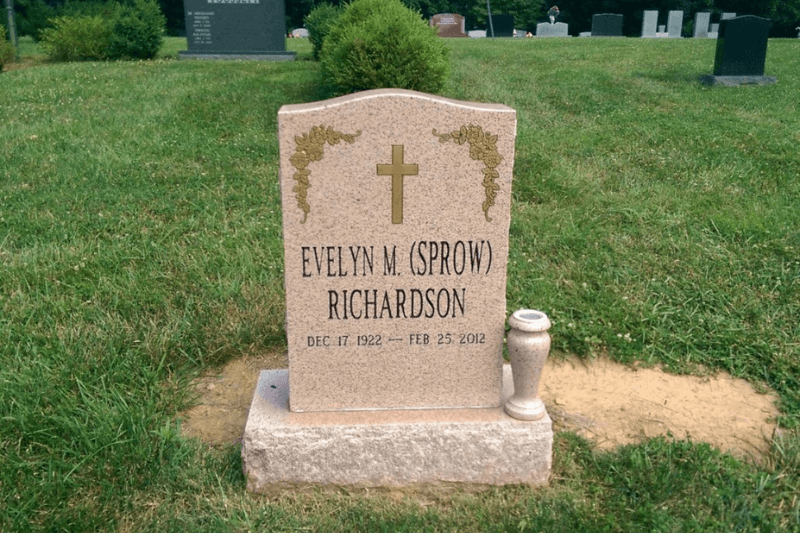
Religious wording should reflect the deceased’s actual beliefs and should be verified carefully before engraving.
Christian Headstone Inscriptions
- The Lord Is My Shepherd
- Well Done, Good and Faithful Servant
- I Am the Resurrection and the Life
- Forever with the Lord
- Saved by Grace
- In God’s Loving Care
- Called Home
- Faithful unto Death
- Her Faith Became Sight
- Safe in the Arms of Jesus
Catholic Headstone Inscriptions
- Requiescat in Pace
- Rest in the Peace of Christ
- In God’s Mercy
- Called to Eternal Life
- Awaiting the Resurrection
- In the Hope of Christ
- May the Angels Lead You into Paradise
Jewish Memorial Wording
Jewish memorials may include English, Hebrew, or both.
Common examples include:
- May His Memory Be a Blessing
- May Her Memory Be a Blessing
- Of Blessed Memory
- A Woman of Valor
- Bound in the Bond of Eternal Life
- Her Children Arise and Call Her Blessed
Hebrew names, Hebrew dates, abbreviations, and traditional memorial phrases require precise review. A fluent reader who understands Jewish memorial conventions should approve the final layout, not only the source text.
Spiritual but Non-Denominational Wording
- Love Is Eternal
- Her Spirit Remains
- Returned to the Light
- Beyond Our Sight, Within Our Hearts
- Her Light Still Guides Us
- His Spirit Lives in Every Kindness
- The Soul’s Journey Continues
- Part of All That Is
Secular Headstone Inscriptions
- A Life of Purpose and Love
- She Left the World Better
- His Example Remains
- Nothing Loved Is Ever Lost
- Her Influence Continues
- He Made the World Kinder
- Remembered in Every Story
- A Life Fully Lived
Verify Every Quotation
Before approving religious, literary, or foreign-language wording, confirm:
- Exact spelling
- Translation
- Punctuation
- Capitalization
- Verse number
- Author attribution
- Foreign-language characters
- Line breaks
A familiar quotation may exist in several translations or versions. The preferred wording should be selected and verified before the design is finalized.
Companion and Couple Headstone Inscriptions
A companion headstone should identify both people clearly while expressing the relationship they shared.
Popular shared epitaphs include:
- Together Forever
- United in Love
- Side by Side
- Two Hearts, One Life
- Partners in Life and Beyond
- Together in Life, Together in Peace
- Love Joined Us, Memory Keeps Us
- Their Love Became Our Legacy
- Reunited
- Still One in Love
One Shared Epitaph or Two Individual Lines?
| Approach | Best suited for |
|---|---|
| One shared epitaph | Couples whose relationship is the central theme |
| One line for each person | Couples with distinct personalities or legacies |
| Shared family line | Parents or grandparents on a family monument |
| Religious shared wording | Couples united by the same faith tradition |
Example with individual lines:
James Robert Ellis
1935 to 2020
His Strength Protected Us
Anne Marie Ellis
1938 to 2025
Her Love Sustained Us
Together They Built a Beautiful Life
When One Spouse Is Still Living
A companion memorial may be installed with the living spouse’s name and birth date already engraved, leaving space for the future death date.
Before approving this arrangement, confirm:
- Who will complete the future lettering
- Whether the original lettering can be matched
- How much space must remain
- Whether the cemetery requires prior approval
- Whether the final layout will remain visually balanced
Personalized Epitaphs Based on Character and Legacy
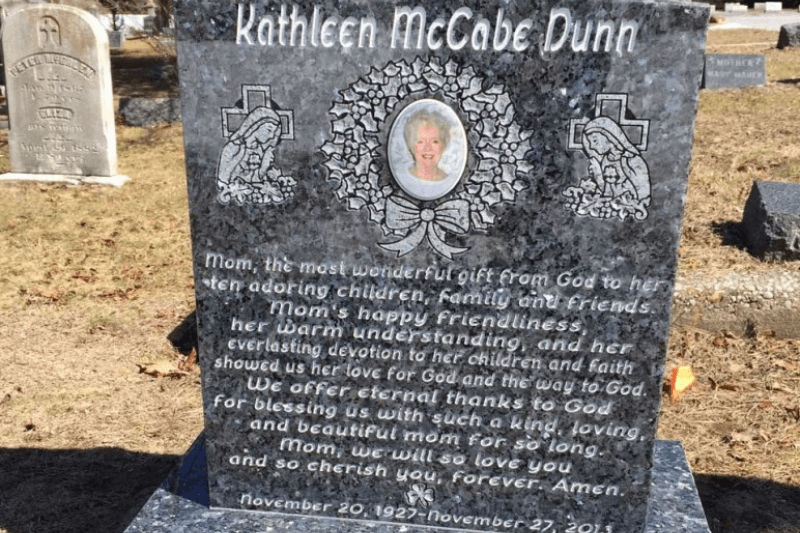
A personalized epitaph preserves a recognizable quality rather than listing every achievement.
Kindness and Generosity
- Her Kindness Made Strangers Feel Like Family
- He Gave More Than He Asked
- Her Door and Her Heart Were Always Open
- He Never Missed a Chance to Help
- She Made Room for Everyone
Family Devotion
- His Family Was His Greatest Pride
- She Made Our Family a Home
- Their Love Became Our Foundation
- He Built a Life That Sheltered Others
- Her Greatest Joy Was Her Family
Teaching and Mentorship
- A Teacher in the Classroom and in Life
- Her Lessons Continue
- He Helped Others See Their Potential
- She Taught with Patience and Led with Care
- His Wisdom Lives in Those He Guided
Service and Leadership
- A Life Given to Others
- He Led with Integrity
- She Served with Courage and Compassion
- His Work Was Service, His Legacy Is Love
- She Left Every Place Stronger
Craftsmanship and Vocation
- Made with His Hands, Given from His Heart
- She Brought Skill and Care to Every Task
- His Work Will Outlast Him
- A Builder of Homes and Relationships
- She Created Beauty with Patience
Music, Travel, Nature, and Personal Interests
- Her Music Continues
- He Followed Every Open Road
- She Found Beauty in Ordinary Days
- A Gardener of Flowers, Friendships, and Hope
- He Was Happiest Beneath an Open Sky
- Her Curiosity Never Rested
A headstone should not read like a résumé. One well-chosen quality often communicates more than a long list of occupations, awards, and hobbies.
Headstone Inscriptions for a Child or Infant
A child’s headstone should use gentle language that honors the child without trying to explain the loss.
For a Baby or Young Child
- Forever Our Precious Child
- Loved for Every Moment
- A Small Life, an Endless Love
- Our Beautiful Little One
- Held for a Moment, Loved for Eternity
- Born into Love
- Our Little Star
- Your Light Remains
- You Filled Our Hearts Completely
- Forever Part of Us
For a Teenager or Young Adult
- Her Joy Was Contagious
- His Courage Inspired Everyone
- She Loved Fiercely and Laughed Freely
- A Loyal Friend and a Beautiful Soul
- His Dreams Continue Through Us
- She Made Every Day Brighter
- Forever Young, Forever Loved
- Your Story Continues in Us
Families should not feel obligated to assign a theological or philosophical meaning to the death. A simple statement of love can be complete and deeply meaningful.
Veteran and Public-Service Memorial Wording
A veteran’s memorial may include formal service information in addition to a personal epitaph.
| Service information | Personal remembrance |
|---|---|
| Rank | He Served with Honor |
| Military branch | Duty Fulfilled, Honor Earned |
| War or service period | Faithful to Country and Family |
| Unit | Courage in Service, Devotion at Home |
| Decorations | A Life of Duty and Integrity |
| Religious emblem | Service Before Self |
Common veteran inscriptions include:
- He Served with Honor
- Duty Fulfilled, Honor Earned
- Faithful to Country and Family
- Courage in Service, Devotion at Home
- A Life of Duty, Sacrifice, and Integrity
- Semper Fidelis
- Fair Winds and Following Seas
- Mission Complete
For police officers, firefighters, emergency medical professionals, and other public servants:
- He Answered Every Call
- Courage in Service, Compassion in Life
- Her Service Was an Act of Love
- His Watch Has Ended
- Brave in Duty, Gentle at Heart
- A Guardian to His Community
When an official seal, badge, branch insignia, or government marker is already present, the epitaph should add personal meaning rather than repeat the same information.
Poetic, Literary, and Song-Inspired Wording
Poetry, literature, hymns, and music can provide meaningful words when a family finds it difficult to create an original tribute.
A suitable quotation should:
- Make sense without the surrounding work
- Reflect the person’s beliefs or personality
- Fit the available inscription area
- Be quoted accurately
- Remain understandable over time
Short traditional or public-domain phrases may be easier to use than long modern excerpts.
Examples include:
- All Shall Be Well
- Love Is Enough
- The Best Is Yet to Be
- I Have Fought the Good Fight
- At the Going Down of the Sun, We Will Remember Them
Long song lyrics and modern poems may be protected by copyright. A short title, an original family sentence, or a paraphrased sentiment may be more practical.
No quotation should be attributed to an author until the original source has been checked. Many familiar sayings are repeatedly misquoted or incorrectly credited online.
Humorous Headstone Sayings
Humor can be appropriate when it reflects the deceased’s established personality and remains respectful in a public setting.
Lighthearted examples include:
- I Finally Found a Quiet Place
- Please Water the Flowers
- Gone Fishing Permanently
- No Forwarding Address
- Out of Office Indefinitely
- Save Me a Seat, but Take Your Time
- At Last, No Alarm Clock
- I Had a Good Run
- Still Making an Entrance
- The Tools Are in the Usual Place
Before choosing a humorous inscription, consider the following questions.
| Question | Why it matters |
|---|---|
| Would the deceased have approved it? | Humor should reflect the person, not only the family |
| Will strangers understand it? | The memorial exists in a public setting |
| Could it hurt close relatives? | A joke may affect family members differently |
| Will it still feel appropriate years from now? | A permanent inscription should age well |
| Does the cemetery allow it? | Some cemeteries review unconventional wording |
Avoid humor based on family disputes, insults, prejudice, or the manner of death.
How Long Should a Headstone Inscription Be?
A headstone epitaph is usually most effective when it fits within one to three short lines.
There is no universal character limit. The available space depends on the monument’s dimensions, material, design, and lettering method.
| Memorial type | Common wording considerations |
|---|---|
| Upright granite headstone | Usually offers the most flexible text hierarchy |
| Flat granite marker | Requires concise horizontal layouts |
| Bronze marker | Must fit within a fixed cast design |
| Companion monument | Must balance two names and two sets of dates |
| Ledger | Provides more surface area but still requires restraint |
| Memorial bench | Text may be divided between the seat, front, or back |
| Cremation niche front | Usually has limited inscription space |
| Mausoleum crypt front | Often requires compact lettering and formal alignment |
The design may also need space for:
- Emblems
- Portraits
- Etched scenes
- Borders
- Vases
- Future dates
- Additional family names
Readability should take priority over fitting every desired word. When lettering must become unusually small, the wording should generally be shortened.
How the Memorial Material Affects the Inscription
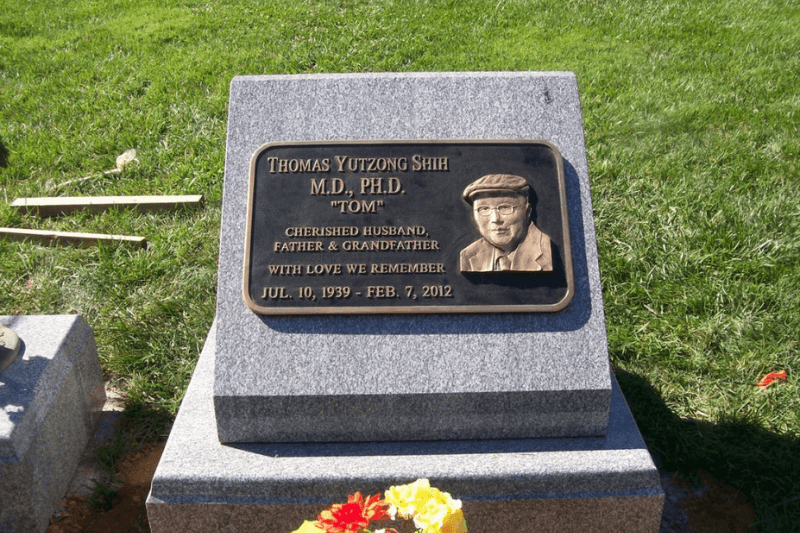
The physical material and engraving process influence the amount, style, and long-term readability of the lettering.
Sandblasted Granite Lettering
Sandblasting is commonly used for granite monuments. Letters are cut into the stone through a stencil.
Legibility depends on:
- Letter size
- Cutting depth
- Granite color
- Surface finish
- Contrast
- Letter spacing
Laser Etching
Laser etching is frequently used on dark polished granite. It can reproduce detailed portraits, landscapes, symbols, and fine lettering.
Because etched artwork can be visually prominent, the inscription should remain clear and should not compete with the image.
Raised Bronze Lettering
Bronze markers generally use raised letters, emblems, borders, and decorative elements. The inscription must fit the manufacturer’s approved layout and the cemetery’s permitted marker dimensions.
Hand-Carved Lettering
Hand carving can add artistic depth and individuality. The lettering style must still remain suitable for the stone and legible at the intended size.
Adding Lettering to an Existing Monument
When a date, name, or inscription is added later, the new work should match the original lettering as closely as possible.
The engraver may need to document:
- Letter height
- Typeface
- Spacing
- Depth
- Alignment
- Finish
- Paint color
- Existing weathering
An on-site survey is often necessary before additional lettering is completed.
Cemetery Rules to Confirm Before Engraving
Cemetery requirements should be checked before the inscription and monument design are finalized.
Regulations can vary between cemeteries and even between sections within the same cemetery.
| Requirement | What to ask |
|---|---|
| Memorial type | Are upright monuments, flat markers, or bronze markers allowed? |
| Dimensions | What are the minimum and maximum sizes? |
| Material | Are certain granite colors or bronze designs required? |
| Emblems | Are religious, military, or personal symbols restricted? |
| Photographs | Are etched or ceramic portraits permitted? |
| Language | Does non-English text require approval? |
| Companion monuments | How should names and future dates be arranged? |
| Installation | Who may install the memorial? |
| Foundation | What foundation specifications apply? |
| Approval | Must the cemetery approve the drawing before production? |
A cemetery may also charge separate fees for foundations, installation, inspections, permits, or additional lettering.
What Not to Put on a Headstone
A permanent inscription should be approached differently from an obituary, funeral program, or social media tribute.
Avoid Unverified Information
Do not rely on memory alone for:
- Middle names
- Birth dates
- Death dates
- Military rank
- Religious text
- Foreign-language wording
- Author attribution
Avoid Excessively Long Wording
Long prose often requires smaller lettering and weakens the visual hierarchy of the memorial.
An obituary can preserve the full life story. The headstone should preserve its central meaning.
Avoid Temporary Family Conflicts
A memorial should not become the final expression of a disagreement about relationships, inheritance, religion, or funeral decisions.
Avoid Inauthentic Language
Do not assign beliefs, titles, or personality traits the deceased would not have recognized.
Avoid Listing Every Relationship
A long list of family roles can make the inscription crowded and may unintentionally exclude someone.
Avoid Unclear Abbreviations
An abbreviation understood by the immediate family may be confusing to future generations.
Avoid Text That Is Too Small to Read
Fitting the words within the available area does not automatically make the design successful. Permanent readability is more important than word count.
How to Proofread a Headstone Inscription
A headstone should be engraved only after the family has reviewed and approved a complete visual proof.
1. Confirm the Name
Check the spelling against a reliable document.
Review:
- Middle names
- Maiden names
- Hyphens
- Apostrophes
- Accent marks
- Suffixes
- Titles
- Nickname punctuation
2. Confirm the Dates Independently
Dates should be checked against official records or dependable family documents. Transposed numbers can be difficult to notice during an emotional time.
3. Review Punctuation and Capitalization
Decide whether the inscription will use:
- All capital letters
- Title capitalization
- Sentence capitalization
- Periods
- Commas
- Ampersands
- The word “and”
- Full dates or years only
Consistency is more important than any single style choice.
4. Verify Quotations
Confirm the exact wording, spelling, punctuation, attribution, translation, and reference.
5. Check Foreign-Language Text
A fluent reader should review the final visual proof and check:
- Character direction
- Accent marks
- Line breaks
- Spacing
- Traditional memorial abbreviations
- Name order
6. Review the Complete Design
A proper proof should show:
- Exact line breaks
- Letter sizes
- Name placement
- Date placement
- Emblems
- Artwork
- Borders
- Reserved space
- Overall alignment
7. Obtain Written Approval
Several relatives may review the proof, but one authorized person should provide final written approval before engraving begins.
Complete Headstone Inscription Examples
Traditional Single Headstone
In Loving Memory
Margaret Louise Carter
May 14, 1941–October 2, 2024
Beloved Mother and Grandmother
Forever in Our Hearts
Minimalist Memorial
Daniel Reed
1958–2025
Personalized Memorial
Sophia Ramirez
1967–2025
She Made Room for Everyone
and Left Every Place Warmer
Companion Memorial
Michael and Rose Bennett
Michael
1934–2019
Rose
1937–2025
Together They Built a Life of Love
Christian Memorial
Samuel James Brooks
1938–2025
A Faithful Servant
The Lord Is My Shepherd
Veteran Memorial
Robert A. Mitchell
Sergeant, United States Army
1948–2024
He Served with Honor
and Loved with His Whole Heart
Child’s Memorial
Lily Anne Parker
2018–2024
Our Beautiful Light
Loved for Every Moment
Jewish Memorial
Sarah Leah Cohen
1942–2025
A Woman of Valor
May Her Memory Be a Blessing
Cremation Memorial
Jonathan Ellis Moore
1955–2025
His Spirit Travels with Us
Frequently Asked Questions
What are common epitaph phrases?
Common epitaph phrases include “Forever in Our Hearts,” “Rest in Peace,” “Gone but Not Forgotten,” “A Life Well Lived,” “Always Loved,” and “Until We Meet Again.”
What three words would you want your epitaph to say?
A meaningful three-word epitaph could be “Kindness Lives On,” “Loved Without Measure,” “Faithful and True,” or “She Brought Joy.”
What is the most common epitaph?
“In Loving Memory” is one of the most common headstone inscriptions, followed by “Rest in Peace,” “Forever in Our Hearts,” and “Gone but Not Forgotten.”
What are some famous epitaphs?
Famous epitaphs include “The best is yet to come,” associated with Frank Sinatra, “Called back” on Emily Dickinson’s grave, and “Here lies one whose name was writ in water” for John Keats.
What is a good example of an epitaph?
“Her kindness made everyone feel at home” is a good epitaph because it is brief, personal, understandable, and focused on a lasting quality.
What is a nice quote for a headstone?
“Forever loved, forever remembered” is a warm headstone quote. Other meaningful choices include “Your light still guides us” and “Love remains.”
How long should an epitaph be?
An epitaph is usually best kept to one to three short lines so it remains readable, balanced, and appropriate for the available engraving space.
What should be avoided on a headstone?
Avoid unverified names or dates, long biographies, unclear abbreviations, inaccurate quotations, temporary family conflicts, and language the deceased would not have chosen.
Can an epitaph be personal instead of traditional?
Yes. A personal epitaph can be more meaningful than a familiar phrase when it reflects the person’s character, values, habits, or influence on others.
Does a headstone need an epitaph?
No. A headstone can include only the person’s name and life dates, especially when space is limited or the family prefers a simple, understated memorial.
Choosing Words That Will Last
A headstone inscription does not need to say everything that could be said about a person. It should preserve the words that matter most and express them with clarity, care, and permanence.
Before approving the wording, confirm that every name, date, title, and quotation is accurate. The inscription should feel authentic to the person, remain readable at an appropriate lettering size, and carry meaning for future generations. A phrase may sound beautiful on paper, but it must also work within the available space and design of the memorial.
Cemetery requirements should be verified before production begins, and the family should review a complete scaled proof showing the exact layout, lettering, dates, symbols, and spacing. The finished inscription should feel neither crowded nor incomplete. It should feel personal, balanced, and worthy of the life it represents.
At Fram Monument Company, families receive thoughtful guidance when choosing, designing, and engraving headstone inscriptions. Experienced memorial specialists can assist with wording, lettering styles, granite and bronze options, cemetery regulations, religious and cultural traditions, and final proof approval. Visit one of our local memorial showrooms to view materials and designs in person and begin creating a lasting tribute that reflects a loved one with accuracy, dignity, and care.