
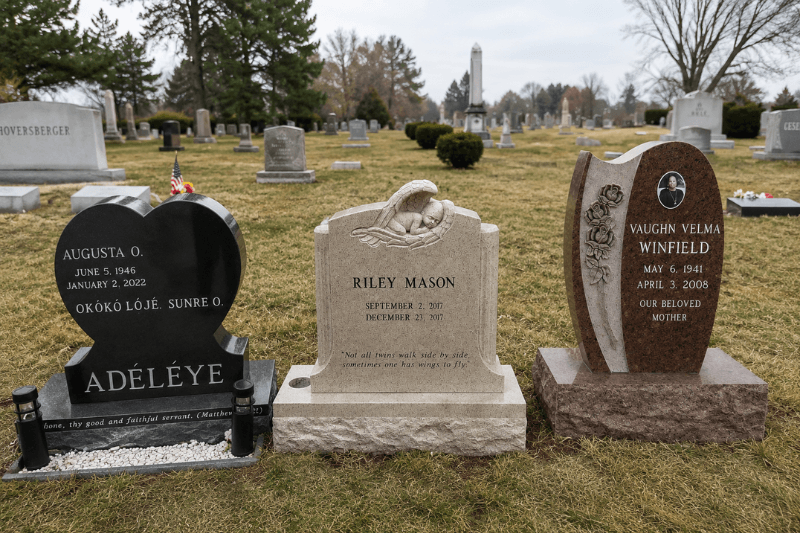
The right granite color for a headstone is one that complies with cemetery rules, keeps the inscription easy to read, supports the intended engraving method, and creates an appearance the family will value for generations.
Granite color affects far more than the general look of a memorial. It influences lettering contrast, portrait detail, perceived size, maintenance visibility, design flexibility, availability, and price. Gray remains a traditional and economical choice, while black is preferred for polished memorials and detailed laser etching. Red, mahogany, pink, blue, green, and multicolored granites offer greater individuality, but their grain and movement must be considered carefully when placing inscriptions.
Because granite is a natural stone, a color name identifies a general variety rather than a perfectly uniform product. The most dependable selection process considers the cemetery, memorial design, inscription technique, physical stone sample, and long-term family plans together.
Key Takeaways
- Verify the cemetery’s color, finish, size, and monument restrictions before choosing granite.
- Gray granite is traditional and highly legible, while fine-grained black granite is generally best for laser-etched portraits.
- Grain, mineral movement, finish, and lettering technique can matter as much as the stone’s basic color.
- A sample represents the granite variety but cannot guarantee an exact match to every finished memorial.
- Choose for readability, design compatibility, maintenance expectations, availability, and future family matching rather than symbolism alone.
Why Granite Comes in So Many Colors
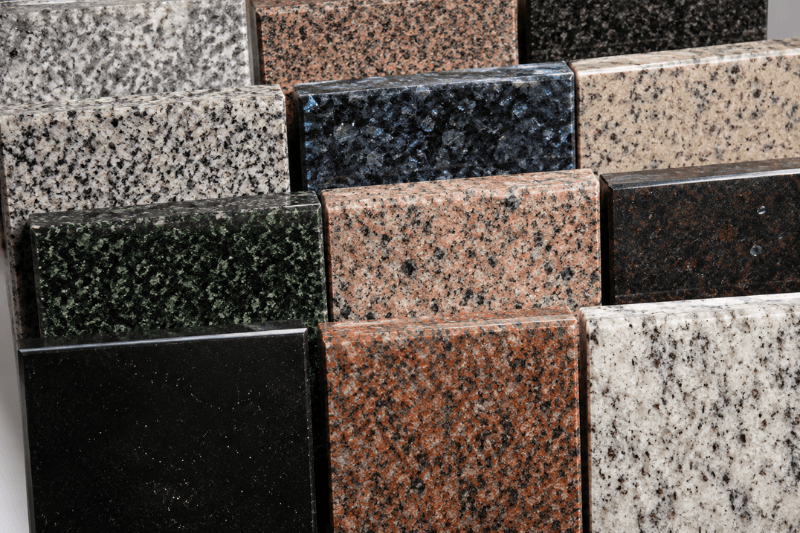
Granite receives its color and pattern from the minerals within the stone, including quartz, feldspar, mica, and darker mineral deposits.
The word “granite” is used broadly in the monument industry for several dense, durable natural stones suitable for exterior memorial work. Their appearance may be nearly uniform, finely speckled, dramatically veined, or filled with reflective mineral crystals.
Light gray granite commonly contains visible white, gray, and black grains. Pink and red varieties receive much of their color from feldspar. Black memorial stone can appear almost solid from a distance, although some varieties contain silver, gray, gold, or bronze flecks. Blue, green, mahogany, and multicolored stones may show more pronounced movement.
These natural characteristics are part of the stone, not printed surface patterns. Each block is cut from a quarry deposit formed over an immense period, so no two pieces are perfectly identical.
Natural Variation Is Not Usually a Defect
Small differences in grain size, veining, mineral distribution, and shade should be expected. A polished sample may accurately show the general color family while differing from the final monument in the exact placement of flecks or bands.
The issue becomes more important with strongly patterned varieties such as Paradiso, Cats Eye, Black Galaxy, Blue Pearl, and some mahogany granites. For these stones, the design should be evaluated against the actual slab whenever possible. A quiet area of the slab may suit the inscription, while a highly active section can be reserved for undecorated surfaces.
Quarry Origin Affects Color and Availability
Granite varieties are commonly identified by quarry or trade names, such as Barre Gray, Dakota Mahogany, Blue Pearl, or India Black. Those names help identify a stone type, but regional suppliers may use slightly different names for similar material.
Domestic gray granite is often easier to obtain and more economical than less common imported blue, green, or deep black stone. Imported material may involve longer freight routes, limited block sizes, changing quarry supply, and greater variation in replacement availability. Competitor and industry pages consistently identify gray as a traditional economical option and dark or exotic imported stones as higher-priced selections.
Most Popular Granite Colors for Headstones
The most common granite headstone colors are gray, black, red, mahogany, pink, blue, green, white, and multicolored stone. Each color family supports different lettering and design techniques.
There is no universally best color. The right choice depends on how the stone will be shaped, finished, engraved, viewed, and maintained.
Gray Granite Headstones
Gray is the traditional reference point for cemetery granite. Barre Gray and Georgia Gray are among the best-known varieties, although other light, medium, silver, and charcoal-gray stones are available.
Gray granite works especially well for conventional sandblasted lettering. The design can be created within a darker polished panel, on a lighter steeled surface, or with contrasting inscription color. Its moderate pattern usually supports names, dates, epitaphs, emblems, and floral carving without making the layout look crowded.
Gray is popular because it is:
- Familiar in historic and contemporary cemeteries
- Compatible with traditional monument shapes
- Readable with multiple lettering treatments
- Relatively forgiving of dust, pollen, and dried water residue
- Commonly available in domestic stone
- Often less expensive than premium black or imported colors
Barre Gray is known for a fine, consistent grain that supports carving and lettering. Georgia Gray can offer a slightly different tone and texture but remains a practical, economical memorial stone. Gray is often the safest choice when a family wants a dignified appearance that blends naturally with an established cemetery landscape.
Black Granite Headstones

Black granite creates a formal, polished, high-contrast appearance. Common trade names include Jet Black, India Black, Impala Black, Imperial Black, Flash Black, and Black Galaxy, although these stones do not all look or perform identically.
Fine-grained, uniform black granite is the preferred surface for laser-etched portraits because the laser removes or disrupts the dark polished surface to reveal a lighter image. The greater the contrast and uniformity of the stone, the more effectively subtle facial tones, hair, clothing, landscapes, and detailed symbols can be represented.
Black granite also works well for:
- White or light-colored lithichrome lettering
- Gold-filled inscriptions
- Highly polished contemporary monuments
- Detailed scenes and photo-realistic artwork
- Designs that combine polished and frosted areas
- Memorials with a restrained, formal appearance
Not every stone sold as black is equally suitable for photographic etching. Black Galaxy contains reflective mineral flecks that create visual interest but may interfere with very fine tonal detail. Impala Black often appears dark charcoal or black-gray rather than uniformly jet black. A monument intended for a detailed portrait should therefore be selected by engraving performance, not by the word “black” alone.
Dark polished stone tends to reveal pollen, fingerprints, dried irrigation water, dust, and bird residue more readily than gray or patterned granite. That does not mean black granite is less durable. It means surface residue is easier to see.
Red Granite Headstones
Red granite produces a strong, distinctive memorial presence. India Red, New Imperial Red, and Wausau Red are widely recognized names, although individual shades range from bright red and rose-red to deep burgundy.
Red granite may contain black, gray, brown, or pink minerals. Some varieties are visually uniform, while others have pronounced movement. Its warm coloring works well for upright monuments, companion memorials, family monuments, slants, and benches.
A red stone can support conventional sandblasted lettering, but contrast must be planned carefully. Dark mineral deposits can interrupt narrow letters, and a busy surface can make small inscriptions difficult to read. Polished panels, light-colored fills, broad letter strokes, and uncluttered layouts usually produce better results than delicate text placed directly across an active pattern.
Color symbolism is personal rather than fixed. Red may suggest love, vitality, cultural heritage, warmth, or simply a favorite color. It does not need a symbolic explanation to be appropriate.
Mahogany and Brown Granite Headstones
Mahogany granite combines brown, burgundy, black, rose, and gray mineral tones. Dakota Mahogany and Rushmore Mahogany are familiar monument varieties with warm, mottled appearances.
This color family suits families seeking something more distinctive than gray without the reflective formality of polished black. It pairs naturally with:
- Traditional serpentine-top monuments
- Companion and family memorials
- Granite benches
- Rustic or wooded cemetery settings
- Bronze plaques and emblems
- Designs using broad carved elements
Mahogany stone can vary significantly from block to block. One slab may appear predominantly brown, while another from the same general deposit may contain more burgundy or black movement. A physical sample is especially important, and larger memorials may benefit from slab-level review.
Pink and Rose Granite Headstones

Pink granite ranges from pale rose to deeper salmon and reddish-pink. Morning Rose and St. Albans Pink are recognized examples.
Pink and rose stones create warmth without the intensity of vivid red. They may contain black, white, burgundy, or gray flecks, giving the surface a softly textured appearance. These colors can be used for traditional headstones, children’s memorials, companion monuments, floral designs, benches, and family memorials, but they are not limited to any gender or age.
As with red granite, the inscription should be tested against the mineral pattern. Large, deeply sandblasted lettering often reads more clearly than thin scripts or highly condensed type.
Blue Granite Headstones
Blue granite is usually blue-gray, silver-blue, navy, or blue-black rather than a flat primary blue. Blue Pearl and Bahama Blue are prominent examples.
Blue Pearl contains reflective mineral crystals that can shift in appearance as sunlight and viewing angle change. From one direction, the stone may look dark charcoal. From another, blue and silver flashes become prominent. Bahama Blue may show more flowing blue-gray movement.
These stones are valued for their unusual depth and visual character. They are frequently selected for contemporary upright monuments, benches, cremation memorials, family estates, and designs with ocean, sky, or nature imagery.
Blue granite is often imported and may cost more than standard gray. Its reflective pattern can also compete with small lettering, so inscription placement and font weight deserve careful attention.
Green Granite Headstones
Green memorial granite ranges from dark forest green to green-black and mottled gray-green. It creates a calm, natural appearance that blends particularly well with grass, trees, and landscaped cemetery sections.
Some green stones are sufficiently dark for light-filled lettering, but many contain movement that makes detailed portrait etching less predictable than it would be on uniform black granite. Green works well for larger inscriptions, carved borders, botanical motifs, rustic monuments, and memorials intended to complement a natural setting.
Because green varieties are less universally stocked, availability should be confirmed before the design is finalized.
White and Very Light Granite Headstones
White memorial granite is rarely perfectly white. It commonly contains gray, black, silver, or pale mineral flecks.
Light granite can create an open, bright appearance and may resemble the visual character of older marble while offering granite’s greater resistance to weathering. However, pale stone provides less natural contrast for conventional frosted designs unless the inscription is deeply cut or color-filled.
Very light granite is generally not the first choice for laser-etched portraits because laser etching depends on a dark polished background. Ceramic or porcelain portraits, carved reliefs, or dark-filled sandblasting may be better options.
Families should also verify cemetery approval. Some historic cemeteries may favor light stone, while other memorial parks restrict granite to a designated palette.
Multicolored and Highly Patterned Granite
Stones such as Paradiso, Cats Eye, Black Galaxy, and certain red, blue, and mahogany granites are selected as much for their mineral movement as for their base color.
These varieties can make a memorial visually memorable, but pattern must be treated as part of the composition. The stone should not be chosen first and treated as a blank background later.
A successful layout usually:
- Places text over the calmest portion of the slab
- Uses fewer, larger design elements
- Avoids thin lettering over high-contrast veins
- Allows the natural pattern to remain visible
- Uses polished panels or contrasting fills when necessary
- Reviews the design at actual monument scale
Granite Headstone Color Comparison
| Color family | Overall appearance | Lettering performance | Portrait etching | Surface residue visibility | Typical price position |
| Gray | Traditional, balanced, understated | Excellent for sandblasting and carving | Limited for photo-realistic etching | Low to moderate | Usually economical |
| Uniform black | Formal, sleek, high contrast | Excellent with light fill or frosting | Best choice | High | Moderate to premium |
| Red | Warm, prominent, distinctive | Good when pattern is controlled | Usually limited | Moderate | Moderate to premium |
| Mahogany | Warm, natural, mottled | Good with bold lettering | Usually limited | Low to moderate | Moderate |
| Pink or rose | Soft, warm, personalized | Good with sufficient contrast | Limited | Low to moderate | Moderate |
| Blue | Reflective, uncommon, contemporary | Good with thoughtful layout | Variable | Moderate | Premium |
| Green | Natural, quiet, distinctive | Good on calmer stone | Variable | Moderate | Moderate to premium |
| White or very light | Bright, open, marble-like | Requires dark fill or deep carving | Poor for conventional laser portraits | Variable | Varies |
| Highly patterned | Dramatic and individual | Depends heavily on placement | Usually secondary to pattern | Often forgiving | Moderate to premium |
These are general tendencies, not guarantees. Exact performance depends on the quarry variety, grain, finish, inscription technique, and monument design.
How to Choose the Right Granite Color
Choose granite only after confirming cemetery requirements, deciding how the memorial will be engraved, and reviewing how the inscription reads against the actual stone.
A color may be emotionally appealing yet unsuitable for a particular cemetery section or design. The most reliable process follows a practical order.
Confirm Cemetery Rules Before Selecting Stone
Cemetery regulations can govern much more than monument dimensions. Rules may address:
- Permitted granite colors
- Upright versus flat memorials
- Bronze markers on granite bases
- Polished or unpolished finishes
- Maximum height, width, and thickness
- Number and location of vases
- Religious or historic-section requirements
- Foundation and installation specifications
- Matching requirements within family lots
Some cemeteries permit a broad range of stone colors. Others restrict memorials to gray, pink, black, or a small approved selection to preserve a uniform landscape. Memorial gardens may require flat bronze markers mounted on granite bases rather than upright headstones.
Color approval should be obtained for the specific section and lot, not assumed from monuments elsewhere in the cemetery. Industry practice recognizes that cemetery rules vary by location and can affect acceptable colors, styles, sizes, and placement.
Decide How the Memorial Will Be Lettered
The engraving method can eliminate certain colors before personal preference is considered.
Sandblasted Lettering
Sandblasting removes stone through a stencil to form letters, numbers, emblems, and decorative elements. It works across many granite colors and is the standard method for cemetery inscriptions.
Gray granite often produces strong results because the contrast between polished and unpolished areas is naturally visible. Red, pink, mahogany, blue, and green can also work well when letter depth, font weight, panel treatment, and color fill are properly coordinated.
Lithichrome and Color-Filled Lettering
Lithichrome is a monument-grade color treatment used to increase contrast within engraved lettering or designs. Black is common on gray or light granite. White, silver, or gold may be used on dark stone.
Color fill should be viewed as a renewable surface treatment rather than a permanent structural part of the granite. Exposure, cleaning, sunlight, moisture, and time can gradually reduce its intensity.
Frosted Panels
A frosted or steeled panel removes the polish from a selected area, producing a lighter matte field. This can create contrast behind an inscription on dark or medium-tone granite.
The panel itself becomes part of the design. Its outline, spacing, and relationship to the polished stone should be shown clearly in the proof.
Laser Etching
Laser etching is most effective on fine-grained, dark, polished granite. Uniform black provides the strongest tonal range for faces, clothing, landscapes, religious art, military scenes, vehicles, and other detailed images.
The claim that only black granite can receive laser work is too absolute. Some dark stones can be etched, but uniform black usually delivers the most predictable photo-realistic result. Flecked or patterned dark granite may reduce fine detail.
Ceramic and Porcelain Portraits
A fired ceramic or porcelain portrait can be used on many granite colors. This provides an alternative when the family wants a color photograph but prefers gray, red, mahogany, blue, or another stone not ideal for laser portraiture.
Evaluate Contrast Before Color Symbolism
A headstone is first a permanent record. Names, dates, relationships, epitaphs, and symbols should remain understandable from a normal viewing distance.
Before approving a stone color, evaluate:
- The length of each name
- The number of inscriptions
- Whether future dates will be added
- Font size and stroke thickness
- The amount of text
- The stone’s grain and movement
- The contrast between polished and engraved areas
- The expected viewing distance
- Whether the monument sits in shade or bright sunlight
A highly patterned stone can be beautiful in a sample yet difficult to read when several lines of text cross contrasting veins. In that situation, the solution may be a calmer slab, a polished inscription panel, heavier lettering, a lighter fill, or a less active granite.
Match the Color to the Memorial Type
The same granite can create different effects depending on monument size and orientation.
Upright Headstones
Upright monuments present the largest vertical surface for inscriptions and artwork. Black works well for etching, gray for traditional lettering, and patterned colors for broad, uncluttered designs.
Flat Grave Markers
Flat markers are viewed from above and may collect more soil splash, grass clippings, irrigation residue, and standing moisture. Extremely dark polished surfaces can show residue clearly. Medium gray, mahogany, pink, and patterned stone often conceal minor surface debris more readily.
Slant and Bevel Markers
The angled face improves readability and sheds water more effectively than a fully flat surface. Most color families can work well, provided the lettering contrasts with the stone.
Benches, Ledgers, and Family Estates
Large memorial elements expose more of the stone’s natural movement. A granite that appears subtle in a small sample may become dramatic across a full ledger or bench. Slab continuity, vein direction, and the relationship among several pieces become important.
Bronze Markers on Granite Bases
A granite base should complement the bronze plaque, cemetery landscape, and nearby family markers. Gray and black are common, but mahogany, pink, and other approved colors may also work. The base must satisfy cemetery dimensions and foundation requirements.
Consider the Cemetery Environment
The surrounding environment changes how color is perceived.
A polished black headstone beneath mature trees may appear almost mirror-like when clean but show pollen during spring. Blue Pearl can flash blue in direct sun and look nearly charcoal in shade. Gray granite may blend gently into an older cemetery, while red or black creates a stronger focal point.
Consider:
- Direct morning or afternoon sun
- Dense shade
- Evergreen or deciduous tree cover
- Nearby irrigation
- Soil color
- Grass and ground cover
- Adjacent monuments
- Cemetery buildings, walls, or mausoleums
- The direction the inscription faces
A color should be judged in conditions resembling the gravesite whenever possible.
Review the Stone in More Than One Type of Light

Online images are useful for narrowing choices, not for making final color decisions. Phone and computer displays alter color temperature, brightness, saturation, and contrast. Showroom lighting can also make polished granite appear warmer or cooler than it will outdoors.
A proper comparison includes:
- A physical polished sample
- A matte or steeled surface, when relevant
- Indoor and outdoor light
- Dry and lightly wet stone
- Close viewing and several feet of distance
- Examples with actual lettering
Wet granite usually looks darker and more saturated. Rock-pitched edges often look lighter than polished faces because the rough surface scatters light. These differences are normal.
Understand What a Granite Sample Can and Cannot Promise
A granite sample represents the typical color and mineral character of a stone, but it cannot guarantee an exact match to every future slab.
This is one of the most important expectations to establish before ordering.
Uniform gray and fine black granite may remain relatively consistent. Strongly patterned stones can vary much more. A small sample might show one red band, while a full monument contains several. A blue sample might display prominent reflective crystals that appear less concentrated in another block.
For highly active granite, ask whether the actual slab can be photographed or approved before fabrication. The photograph still will not reproduce color perfectly, but it can reveal major veins, mineral clusters, and design conflicts.
Think About Future Family Memorials
A new headstone is sometimes the first part of a larger family arrangement. Future needs may include:
- Adding a date of death
- Placing a matching footstone
- Creating a companion memorial
- Adding another marker in the same lot
- Matching a bench, ledger, vase, or coping
- Reproducing the family surname on a second monument
Natural stone from a later quarry batch may not match perfectly. Quarry deposits change, suppliers change, and some varieties become difficult to source.
Keep written records of:
- Granite trade name
- Quarry or supplier, when known
- Finish
- Monument dimensions
- Lettering style and size
- Inscription color
- Design proof
- Installation date
- Photographs in natural light
Matching an existing monument requires more than identifying the general color. Grain, polish, letter depth, font, spacing, panel treatment, and weathering must also be documented. Experienced field measurement commonly includes these details when reproducing an existing family memorial.
Balance Budget With the Complete Memorial
Gray granite is often the most economical choice because common domestic varieties are widely available and produce efficient quarry yield. Black, blue, green, and other imported colors may cost more because of freight, quarry supply, processing demands, and block availability.
Color is only one part of the final cost. Pricing may also reflect:
- Monument size and thickness
- Shape and edge work
- Number of polished surfaces
- Carving depth
- Laser artwork
- Vases or accessories
- Foundation requirements
- Cemetery fees
- Freight and installation
- Custom slab selection
- Matching work
A smaller memorial in premium black granite may cost less than a large gray family monument. General statements about color pricing should therefore be treated as relative, not as complete estimates.
How Finish Changes Granite Color
Granite finish changes how light interacts with the stone, making the same color appear darker, lighter, brighter, or more subdued.
Color and finish should be selected together.
Polished Finish
Polishing deepens the color and increases reflection. Black becomes richer, red becomes more saturated, and blue or metallic crystals become more visible.
A polished surface:
- Creates strong visual depth
- Supports laser etching on dark granite
- Provides contrast with frosted panels
- Wipes clean relatively easily
- Shows water spots and dust more clearly on dark stone
- May be restricted by some cemeteries
Steeled, Honed, or Matte Finish
A nonreflective finish softens color and reveals more of the stone’s granular texture. Black may look charcoal, and red may appear lighter or more muted.
Matte surfaces often create a traditional or understated character. They can also reduce glare, which may improve inscription visibility in direct sun.
Rock-Pitch Finish
Rock-pitch refers to a deliberately rough, hand-worked or mechanically textured edge. Because the surface is not polished, it appears lighter and more irregular than the polished face even though both are cut from the same block.
This contrast is often used intentionally on upright monuments, slants, bases, and benches.
Mixed Finishes
Many successful headstones combine:
- A polished face
- Steeled inscription panels
- Rock-pitched edges
- Polished tops
- Frosted floral designs
- Unpolished backs or sides
The design proof should identify each finish. A stone color viewed only as a fully polished sample may look different when much of the finished memorial is matte or textured. Recent competitor coverage also emphasizes that finish changes reflection, dirt visibility, and the overall appearance of a stone over time.
Best Granite Colors for Specific Memorial Features
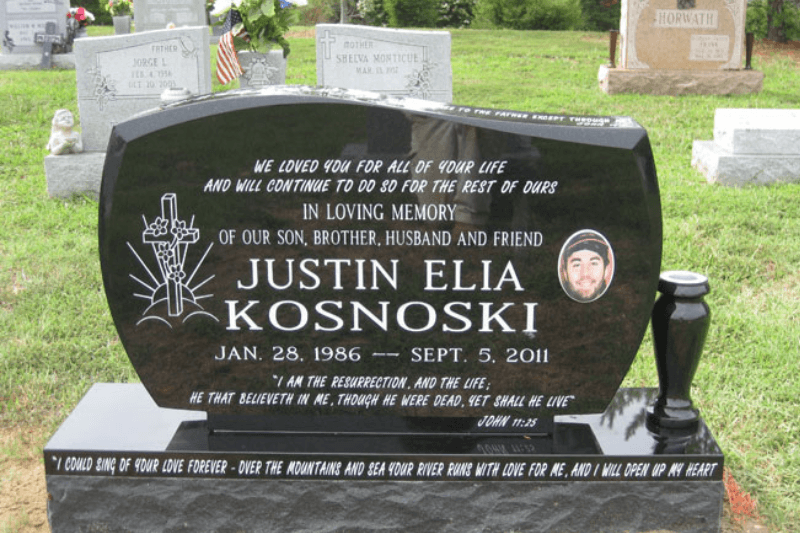
Best for Laser-Etched Portraits
Uniform, fine-grained black granite is the standard choice. Jet Black and certain India Black varieties usually provide the strongest contrast and most predictable tonal detail.
Best for Traditional Sandblasted Lettering
Fine-grained gray granite is especially versatile. Black, red, pink, mahogany, blue, and green can also perform well when the lettering treatment is designed for the stone.
Best for Deep Carving and Floral Designs
Gray granite provides excellent visual separation between carved and polished areas. Medium-tone red, pink, and mahogany may also support carved roses, religious symbols, borders, and scrollwork when the grain is not overly active.
Best for Gold or White-Filled Lettering
Dark black or charcoal granite creates the greatest contrast. Deep green and dark mahogany can also work, subject to the stone pattern.
Best for Long Inscriptions
Calm, fine-grained gray or uniform black is generally easier to organize than a dramatic multicolored slab. Long text benefits from visual simplicity.
Best for Bronze Markers
Gray and black bases are widely used because they coordinate easily with bronze. Mahogany, pink, or other approved granite can provide a warmer appearance.
Best for Matching an Existing Family Monument
The best color is the closest available match to the existing stone, but color name alone is insufficient. Finish, grain size, mineral movement, weathering, inscription treatment, and dimensions should also be matched.
Granite Color, Durability, and Maintenance
Granite color does not by itself determine whether a headstone is durable; stone quality, mineral structure, fabrication, foundation, installation, climate, and maintenance all affect long-term performance.
Granite is widely used for memorials because it is dense, strong, weather-resistant, and compatible with exterior lettering. Its broad color range also provides more design flexibility than many traditional stones.
Dark Stone Does Not Wear Out Faster Because It Shows Dirt
Black granite may appear to require more care because residue is visible against a dark polished surface. The stone itself is not necessarily deteriorating. Dust, pollen, mineral-rich sprinkler water, and dried rain spots simply create stronger contrast.
Light and Patterned Stone Can Conceal Surface Residue
Gray, pink, mahogany, and active multicolored granite often conceal light dust and water spotting. They can still become dirty, but the residue may be less noticeable from a distance.
Safe Cleaning Matters More Than Frequent Cleaning
Routine care should be gentle. Plain water, a soft natural or nylon brush, and a stone-appropriate neutral cleaner are usually safer than harsh chemicals.
Avoid:
- Wire brushes
- Household bleach mixtures
- Acidic cleaners
- Abrasive powders
- High-pressure washing
- Scraping with metal tools
- Unapproved sealers or coatings
A memorial should not be cleaned solely to restore a wet, showroom-like shine. Overcleaning can be more damaging than ordinary outdoor aging.
Inscription Color May Need Renewal
Lithichrome and other surface-applied color treatments can fade or wear over time even when the carved letters remain structurally sound. Renewal may restore contrast without recutting the stone.
Does Granite Color Affect Headstone Cost?
Granite color affects price mainly through quarry supply, origin, block availability, uniformity, freight, and fabrication requirements.
Standard gray is commonly among the most affordable options. Premium black must often meet stricter uniformity standards, especially for photo etching. Blue, green, and unusual imported stones may carry higher material and transportation costs.
Highly patterned stone can also require more selective cutting. A fabricator may reject portions of a slab that place an undesirable vein through the inscription area, reducing usable yield.
Cost may rise when a family requests:
- An exact or close match to an older monument
- A rare quarry variety
- An oversized single slab
- Several pieces cut from the same block
- A highly uniform black etching surface
- Full polishing on multiple sides
- Slab photography or special selection
- Expedited replacement of unavailable material
The most economical stone is not always the least expensive memorial overall. A granite that needs complex contrast treatments or special sourcing may alter the total design cost.
Common Granite Color Selection Mistakes
Choosing Color Before Checking Cemetery Rules
A family may become attached to a blue, red, or polished black stone only to learn that the cemetery section permits gray markers or bronze plaques exclusively.
Relying on a Phone Image
Screens cannot reliably reproduce granite color, reflectivity, grain, or scale.
Assuming All Black Granite Is the Same
Jet Black, India Black, Impala Black, Flash Black, and Black Galaxy differ in tone, grain, flecking, and engraving performance.
Ignoring Lettering Contrast
The stone should support the inscription, not compete with it.
Treating Symbolism as a Rule
Online color meanings are interpretive. Gray does not have to symbolize neutrality, and red does not have to symbolize passion. Personal, cultural, and family associations are more relevant than generalized charts.
Expecting an Exact Sample Match
Natural stone varies. A small sample cannot show every possible mineral pattern in a full monument.
Forgetting Future Inscriptions
A companion headstone must reserve space for later dates and possibly additional wording. The granite and lettering system should remain practical for on-site addition.
Matching Color but Not Finish
A new stone in the correct color family may still look noticeably different if the older memorial is steeled, weathered, or rock-pitched while the replacement is highly polished.
Allowing Pattern to Overpower the Design
A dramatic slab can be effective, but too much lettering and ornament on active stone reduces clarity.
Confusing Visible Residue With Poor Durability
Dark polished granite shows surface marks more readily. That is a maintenance-visibility issue, not proof of inferior stone.
Granite Headstone Color Selection Checklist
Before approving the order, confirm the following:
- The cemetery permits the color, finish, monument type, and dimensions.
- The engraving method is suitable for the selected stone.
- Names and dates remain readable at normal viewing distance.
- Portraits, emblems, and decorative carving have enough contrast.
- The color has been reviewed on a physical sample.
- Natural shade and pattern variation are understood.
- Strongly patterned slabs have been reviewed when practical.
- Existing family monuments have been measured and documented.
- Future inscriptions or matching memorials have been considered.
- The written order identifies the granite trade name, finish, and inscription treatment.
Frequently Asked Questions
What Is the Best Color Granite for a Headstone?
The best granite color for a headstone is one that meets cemetery requirements, provides clear inscription contrast, supports the desired artwork, and fits the family’s preferences. Gray is highly versatile for traditional sandblasted lettering, while uniform black granite is usually best for laser-etched portraits and detailed imagery.
What Is the Most Popular Granite Color?
Gray is the most popular granite color for headstones. Varieties such as Barre Gray and Georgia Gray are widely used because they offer a traditional appearance, strong lettering visibility, broad cemetery acceptance, and relatively economical pricing.
How Do You Choose a Monument Color?
Choose a monument color by first confirming the cemetery’s rules, then considering lettering contrast, engraving method, maintenance, budget, surrounding family memorials, and the natural variation of the stone. Review a physical granite sample in natural light before making a final decision.
What Granite Color Is Best for Engraving?
Gray granite is one of the best choices for traditional sandblasted lettering and carved designs. Fine-grained black granite is generally the best choice for laser etching because it creates strong contrast for portraits, landscapes, and detailed artwork.
Is Black or Gray Granite Better for a Headstone?
Black granite is better for photographic laser etching, light-colored lettering, and a polished contemporary appearance. Gray granite is better for traditional carving, lower-maintenance visibility, broad cemetery compatibility, and a more economical memorial.
Which Granite Color Shows the Least Dirt?
Gray, pink, mahogany, and other patterned granites usually conceal dust, pollen, dried water spots, and minor surface residue better than polished black granite. The stone still requires appropriate care, but surface marks are often less noticeable from a distance.
Does Granite Color Affect Headstone Durability?
Granite color alone does not determine durability. Stone quality, mineral structure, thickness, fabrication, foundation, installation, climate, and maintenance have a greater effect on how well a headstone performs over time.
What Color Granite Is Best for a Laser-Etched Portrait?
Uniform, fine-grained black granite is the best choice for a laser-etched portrait. Its dark polished surface creates the contrast needed to reproduce facial details, shading, clothing, and background imagery.
Are All Granite Headstone Colors Allowed in Every Cemetery?
No. Some cemeteries restrict granite colors, finishes, monument styles, dimensions, or combinations of granite and bronze. Approval should be obtained for the specific cemetery section and grave lot before the stone is ordered.
Can a New Granite Headstone Match an Existing Family Monument?
A new headstone can often be closely matched to an existing family monument, but an exact match may not be possible. Natural stone varies between quarry blocks, and older monuments may have changed in appearance because of weathering, surface treatments, and age.
Choosing a Color That Will Still Feel Right Years From Now
Granite color should be selected as part of the entire memorial rather than as an isolated decorative choice. The strongest decisions begin with cemetery approval, then account for inscription method, contrast, monument form, surroundings, stone variation, maintenance visibility, budget, and future family needs.
Gray remains enduring because it is adaptable and highly readable. Black offers exceptional contrast and unmatched potential for detailed laser artwork. Red, mahogany, pink, blue, green, and multicolored granites allow a memorial to carry a more individual visual character.
The final test is simple: the stone should support the person’s name and story clearly, fit its cemetery setting respectfully, and remain visually meaningful without depending on a temporary trend.
At Fram Monument Company, we help families compare granite colors, natural patterns, finishes, lettering styles, and engraving options in person. Seeing the stone firsthand makes it easier to evaluate contrast, polish, grain, and how a color may appear in a cemetery setting. Explore our showroom locations or contact us to schedule a consultation and choose a granite color that will honor your loved one with clarity, dignity, and lasting meaning.